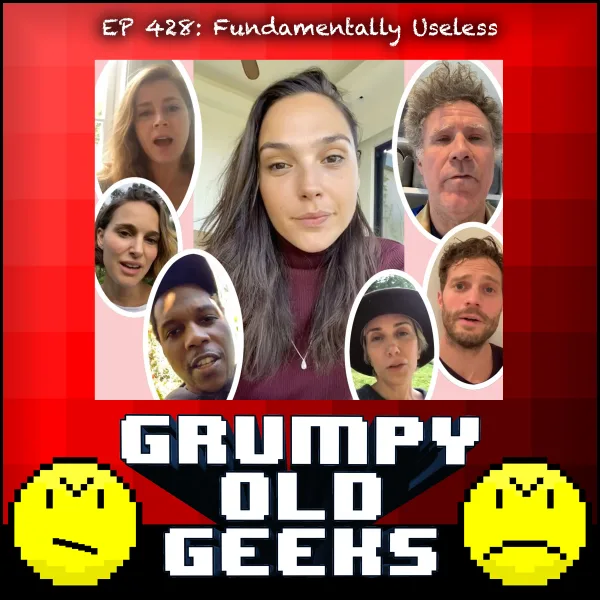
428: Fundamentally Useless
View episode on the publisher’s site
The publisher’s audio length has changed since transcription. Ads may differ, so timestamps may be offset.
Summary
In this episode, Grumpy Old Geeks discusses life during the COVID-19 pandemic, including masks, disrupted services, workplace changes, and concerns about Zoom. The hosts also consider health claims, alcohol sales, home entertainment, and the early days of personal computing.
- The hosts describe changes to their social lives and discuss illness among people they know.
- They examine Zoom meeting intrusions and the company’s response to security and privacy concerns.
- They discuss disruptions affecting Airbnb hosts, Amazon warehouse workers, restaurants, grocery delivery, and DoorDash drivers.
- They consider thermometer and phone location data used to track illness and travel, including the need for context when interpreting rural travel.
- They discuss whether a recession could accelerate workplace automation and examine relief offered as product credits.
- They cover closures of pop-up attractions, Bird’s layoffs, and changes to Apple services.
- They contrast a claim about whiskey and COVID-19 with the World Health Organization’s statement that drinking alcohol offers no protection, then discuss Ina Garten’s cocktail video and a study of dark humor.
- With Dave Bittner, they discuss pandemic life and reminisce about early computers, modems, bulletin board systems, and programming.
- Jason DeFillippo describes Gasolina Cafe’s option to purchase meals for local hospital workers and first responders.
Key moments
-
Life during the pandemic
The hosts discuss masks, illness among people they know, a shared playlist, and changes to their social lives.
-
Services respond to disruption
Zoom’s security problems lead into a discussion of Airbnb host payments and protections for Amazon warehouse workers.
-
Tracking illness and economic effects
The hosts examine thermometer and mobility data, automation, delivery problems, relief offers, and pop-up attraction closures.
-
Apps, layoffs, and home entertainment
The conversation turns to Apple services, Bird’s Zoom layoffs, online readings, iPad use, and alcohol sales.
-
Alcohol, Ina Garten, and dark humor
The hosts discuss a claim about whiskey and COVID-19, Garten’s cocktail video, and a study of dark humor.
-
Pandemic life and Zoom meetings
Dave Bittner joins the hosts to discuss life at home, economic concerns, and disruptions to virtual meetings.
-
Early computers and online life
The speakers recall modems, bulletin board systems, computer games, programming, and old hardware.
-
Meals for first responders
DeFillippo describes Gasolina Cafe’s option to buy meals for local hospital workers and first responders.
Full transcript
-
Grumpy Old Geeks. A weekly talk show hosted by Brian Schulmeister and Jason DeFilippo discussing the finer points of what went wrong on the internet and who's to blame. Welcome to Grumpy Old Geeks. I'm Jason DeFilippo.
-
And I'm Brian Schulmeister. I have reached the stage of coronavirus where I desperately need a haircut and shaving no longer seems necessary. That's about it, man. I'm like, I looked at myself, I mean, like one week into it, because I was already ready for a haircut. I'm like, man, I should make an appointment at Floyd's. Oh, shit.
-
Yeah. And my wife and I have decided we are not going to give each other haircuts. We shall just suffer through this. I'll be wearing a lot of caps over the next few days, I suppose. Next few months. I'm going to have nice Fabio-esque hair at the end of this. No, I know. Yeah, no, it's not good. I was going to say I would grow a beard for this, but, you know, I can go like three months without shaving and I still just look like an old Italian woman.
-
Yes, that's true. You are follically, facially challenged. I am follically challenged, yes. Me, on the other hand, my five o'clock shadow comes in at noon, so. Yeah. Yeah. No, fortunately, I have many blades left, so I'm good. I'm good to go.
-
Yeah. So in the big news, I suppose, we know that masks are the new masks. Oh, Jesus Christ. We actually should have been wearing them all along, and it does stand to make a little bit of sense. Again, you know, unless you've got the medical grade, which they're still asking us not to buy because we need those for hospitals and all that sort of stuff.
-
You know, it doesn't stop it from getting in, but what it does do is if you're asymptomatic or you happen to be carrying it and you're out and about in public and you cough or sneeze, it does stop a lot of it from getting out. Yeah, and it turns into a really gross thing that's stuck to your face if you sneeze.
-
Yes, but it is effective in that sense. And, you know, one of the reasons that so many of the Asian countries have seen far lower levels is wearing masks as part of the culture when they're sick to protect other people. Yeah, yeah. I mean, yeah, they always say, you know, you do it to protect other people.
-
But the thing is now, yeah, they've come back with the whole asymptomatic thing. But my roommate had a had a theory and I thought it was actually sounded she ran it bastard doctor and the doctor doctor actually goes, yeah, that's actually a pretty good, pretty good theory you got there. If you're wearing like an N95 mask and you don't have it fitted properly and some virus gets in and then it's stuck in there and it just kind of bounces around and you're breathing it in over and over again.
-
It's like, oh, so you have to fit those N95 masks if you have them properly. I still have a few around. So we wear those out when we go to the store, but you have to fit them properly. That is the key to the N95 masks because, you know, we have fires here.
-
I didn't I'm not hoarding them. I'm not I didn't go out and buy them before I had I had a stash of them from the last fires. And most of them I've actually given away to my neighbors and friends. So I've only got a couple left, but you got to wear it. You got to get to follow the instructions when you put those things on and don't try and one hand because like they have this little nose bridge that you're supposed to fit to your nose properly, very tightly.
-
And I see a lot of people try and put them on and do it with one hand. You can't do it with one hand. If you do it with one hand, it's not going to work. Use both hands when you're putting on an N95 and fitting it to your face. That's just a pro tip. And the other pro tip that the doctor told us was when you take off the mask, never touch the mask. If you haven't washed your hands, like coming back from the store, always take it off from the straps and put it inside a Ziploc bag because the lack of air inside the Ziploc bag will also kill the virus that if it got on the mask.
-
So leave those in a bag overnight that is definitely sealed and that will help prevent anything from growing on the mask when it is not on your face. There you go. There you go. So a lot of people have, you know, I keep seeing these memes like, hey, do you really know anybody that's actually been affected by this virus so far?
-
And most people are saying, no, I don't. I don't know anybody that's sick. I don't know anybody that's died. Well, here in our household, we actually do have a death in the so-called family. Music manager Gary Salzman, which is a very long-time friend of my roommate's, has died this week of the corona in New York City.
-
So, yeah, it happens. Yeah, I personally don't know anybody that's passed away yet, but I am one or two steps removed from at least four people that I know have it and are in hospital. So it's out there. I'm sorry, man. Yeah. I'm sorry. You know, well, I know a lot of people, so, yeah.
-
Oh, that's right. You're a social maven. Yeah, and earlier this week, as a joke, I kind of started making a COVID-19 playlist. It was kind of fun. And then all of a sudden, all my friends hopped on board.
-
So this is friend-sourced, not cloud-sourced. But we have put together the All Alone Together C19 playlist, and maybe it'll help you pass the time. We'll have the links in the show notes. You can get to it by going to gog.show slash alone. And I do mention it's friend-sourced, not cloud-sourced, because apparently Jason has returned to Facebook with a vengeance, and I've become a verb.
-
You shulmeistered your Facebook feed. I'm shulmeistering my Facebook feed, because you're always so, like, on board with, like, hey, yeah, my Facebook feed is so curated that, you know, you can't even get the Rona in there. So I am shulmeistering my feed.
-
So if you're following me now, and I don't know you in person, there's a very good chance that you will be unfollowed very soon. You're going to get shulmeistered. You're going to get shulmeistered. That's right. So I am, you know, after our last show, and we talked about, you know, that cell phone tracking company that has just space-age technology, I just, I give up.
-
I give up. Might as well be on Facebook at this point. Exactly. And you know what, all I'm going to see is benefit from it, because a lot of you guys are on there, like you and Teeter and Trent, and everybody's having great conversations, and I'm missing out on it. So I'm like, this is what I've been saying about Facebook all along.
-
It took a pandemic for you to come around to my point of view. It really did. It really did. It took a pandemic. If you put in the time and effort to curate your Facebook feeds, if you don't add everybody known to man, if you don't follow every brand known to man, it can actually be value-added, a good time.
-
Yeah. Yeah. No, I'm just following you guys, and I was like, man, I'm missing out, so I should get back on this. I have shulmeistered, or I am in the process of shulmeistering my feed. So, yeah, if you know me in person, that's my only rule.
-
I got to know you. I have to have at least met you. Yeah. Yeah. Yeah. And I mean, some people I do know virtually and have talked on the phone with, and if we've had conversations, you can get past that filter. But, you know, like randos from the podcasting community, I'm sorry, guys. You're out. You're out.
-
Yeah, save that for other things. Keep your Facebook something that's actually useful to you. I agree. Yeah. I'm glad you've joined my team. Yeah. If you want to just shoot this shit with me and follow random stuff, Twitter. That's what Twitter's for. Exactly. At JPDef on Twitter. There you go. And at JPD on Instagram, if you want to see pictures of the puppies.
-
Right. Oh, I did post a picture of one of the teddy bears. Oh, yeah, I saw that. Yep. It's real. The teddy bears exist, man. And just more follow-up. I finally watched the Honest trailer for Rise of Skywalker that you asked me about last episode.
-
And I have to honestly say, I liked it better than the movie. Told you. Told you. Oh, those Honest trailers are just the best. They are really good. They really are. So whatever happened to that big Instacart and Whole Foods strike? It has seemed to have disappeared from the news.
-
Yeah. I mean, I hope that they got some concessions. I hope that they got hazard pay. I hope that they got a bunch of the things that they were asking for. Somehow, I doubt it. But, you know, given my wife and her basic decree that we are not leaving this goddamn house until this blows over, I need Instacart and Whole Foods.
-
So they better keep it up. They are an essential service right now. So hopefully something happened. I haven't seen anything in the news about it either, which is weird. Yeah, I'm guessing that they conceded because they know that, you know, they're cooked. Their goose is cooked if they don't keep these people happy.
-
Yep. Agreed. Yeah, I got a note from the CEO of Ralph's this morning, or basically Kroger, who has like all the million different brands. But here in Southern California, it's Ralph's saying that they are taking care of that. They're giving them an extra $2 an hour hazard pay, putting up plexiglass shields at every checkout line and, you know, paid leave for anybody that comes down with the virus for 14 days.
-
And an extra bonus for people who are staying on the front lines. So, but if I'm telling you, if you go to your grocery store, tip them, give them, give them a 10, give them a five, give them a 20 if you can, because they appreciate it and they need it. And they're, they're doing the Lord's work. Yes, they are.
-
They brought me a case of beer yesterday. So I'm very excited about that because I'm going to be doing my, I'm going to be doing some of my first virtual happy hours this weekend. I've avoided doing it, but the pressure to do so and the need to get a little bit more social again has finally taken hold. So thank you for all the light beers.
-
We got, we got a case of J. Lore Cabernet and six cases of White Claw delivered yesterday. Thank you, Total Wine. We love you. Right. Yeah. So we've been talking about Zoom as well, because a lot of people are saying it's a privacy travesty and all that sort of stuff.
-
And there's all the porn problems that have been happening with it. And it's still to this, to this point, I mean, I can't, speaking of my curated Facebook feed, I have some longtime friends that I used to work with way back in the day. And you think that they would understand technology, but they were posting on their feeds about how they actually got bombed on some of their Zoom meetings.
-
And I just write back, password, password, this is not that difficult, people. But so that does solve the problem. But the only reason I wanted to put this up here in our notes is because of the term that has come out of this, which we didn't have when we were first talking about it.
-
Zoom bombing. Zoom bombing. I like that. That's a brilliant term. I was thinking, you know, if a penis shows up, you've been me zoomed. Yeah. So good stuff. Yep. So they're, they're really kind of working on that right now.
-
They have actually frozen all of their development and put their entire team on security and privacy fixes because they have to, I mean, they have no choice. You know, I mean, this is trial by fire for software, right? Yeah. All of a sudden the entire country is using your software and then you go, oh, boy, we had a lot of bugs in this thing.
-
Exactly. Oh, how's that technical debt working out for you now? So at least they're going to spend the next 90 days to figure this out. I'm guessing it's probably going to go longer because that's a, yeah, that's a tight turnaround for something so complex is, is what they're doing. But yeah, no, I mean, at least they're, they're trying and cause they're a public company.
-
They have to, I mean, their stock price shot up and it dumped again when all these privacy issues came out. So we'll see, we'll see what happens, but right now is probably the time to buy. Probably, yes. And speaking of companies that absolutely have to do something if they want to even pretend to be around when this is all over, Airbnb has put together a $250 million fund to pay to hosts who have been impacted by the coronavirus.
-
This means if a guest cancels a reservation for check-in between March 14th and May 31st, as they will, because nobody's traveling, Airbnb will pay the host 25% of what they would normally receive through their cancellation policy. They are saying this will apply retroactively to all cancellations during the period.
-
So they're trying to do right by their hosts who, you know, have basically lost all income and it enabled, you know, we talked about this a bit earlier. They were enabling guests to cancel reservations and Airbnb just kind of shrugged and went, well, tough shit. So yeah, at least they're stepping up and giving them at least here's a, here's a, here's a pickle for you.
-
Yeah. Yeah. Here's a little bit. So the thing that I didn't like about this, and I didn't put this in the show notes, but it is in the article that's linked in our, in our thing is there's a special set of funds that are being set aside just for what they call their, their mega hosts. These are the people with like the million dollar mansions that put them up on Airbnb for exorbitant amount of money.
-
Screw them. They're fine. The slumlords that have apartment buildings that they've been renting out illegally, probably. Perhaps. Yes. Yes. So Amazon has finally stepped up a bit and they are going to start doing temperature checks. No touch temperature checks and giving masks to all their warehouse workers.
-
All right. So yeah, day late and a dollar short for a lot of people, but yeah, if you've got a temperature over a hundred point four, then you have to go home and, and they're getting surgical masks, not the N95 masks, but you know, Hey, just a little bit helps. Yeah.
-
Every little bit helps. And they're going to start cleaning a lot more, which is because you know what you don't want Amazon employees that are boxing up your stuff to do sneeze all over the box. Yeah. Or like that guy on TMZ spit on it. Yes. Well, I think he would have found a way with, with or without the mask.
-
Yeah. He should have done it in the van if he was smart, but it's apparently not smart. Oh man. So yeah. From, from the, from the, from the archives, let's talk about some old tech news. Finally, Anthony Levandowski. Remember him? I do.
-
Yeah. He's the guy that worked at Google and then went to Uber. Oh, at first he started auto, the trucking company, the autonomous trucking company that Uber then bought. So they could, you know, theoretically have a hands-off buy from this guy. Right. Well, turns out that Uber knew all along that he had all of this info from Google and they said that they would protect him and cover all of his legal costs.
-
Well, you know, he had $179 million judgment handed down to him from Google or Alphabet and he's, he's come coming back and suing Uber saying these guys promised to pay for it. So they need to pay the $179 million.
-
Wow. Maybe crime doesn't pay. I mean, I mean, it's douches all the way down here. It's a straight douche ladder. There's no doubt about that. It's a douche ladder. Yeah. Here's the, here's the, here's the fucked up part. Even if he paid the $179 million fine, he would still be worth about $10 million.
-
I don't get how these people get so goddamn rich. I just don't get it. It's amazing. It really is amazing, isn't it? Yeah. Yeah. Oh God. What are you going to do? Keep talking about it and getting angry. That's what we're going to do. So, and I got to say, thanks to the Rona, we missed our seventh anniversary, Brian.
-
Oh, I didn't even notice. We turned seven on March 25th. So this show is now over seven years old. So we're going to round up and say, this is an eight year old podcast. Congratulations to us. Yeah. Yay us. In the news.
-
Now, Brian, I found this over at Boston.com and it's called restrictions are slowing coronavirus infections. New data suggests. Now I, my roommate sent this one to me because she knows I'm into this kind of thing. And it turns out this article is about Kinza's thermometers.
-
These are IOT thermometers. And we've made fun of these a long time ago. Yes, we did. When they first came out. And turns out they're actually kind of useful. Who'd have thunk it? They're using the data from the, you know, the IOT thermometers to track influenza.
-
That's what their original purpose was. Yes. But now they're actually tracked since the flu season's over in North America, they're using them to track, you know, COVID-19 infections. Right. And it's pretty interesting data. I'm sure it's anonymized. I don't even think they, I don't even think they even bother.
-
They don't bother because you, you, you opt into it. So it's, it's fine. You know, they're just, they're looking for clusters of infections and they've also got a map called the U S health weather map at healthweather.us. And you can see like how things are spreading and what's typical, what's atypical, what's outside of the scope of normal normalcy.
-
But yeah, I mean, it's turning out that all the shit we made fun of can be useful if there's a pandemic in normal, normal use. No, but normally there's a pandemic pandemic. Yes. All rules are out. So yeah. Yeah. It's the problem is always scaling things back after, but we'll see what happens.
-
Yeah. Yeah. Dude, nothing is going to be, that's a whole other show. Yeah. That is a whole other show. We'll talk to Dave about that shortly, probably. But yeah, the, the, you know, the horses have left the barn and welcome to the new normal people. Yeah. So I took a good look at that health weather us map.
-
It's really cool. There's a lot of great data visualizations going on right now. And you know, I'm going off the cuff here because I actually didn't have this in the show notes, but the wall street journal, I believe it was either the wall street journal. Yes, it was the wall street journal did a map of people using anonymized cell phone data in the U S and who has been traveling and who hasn't been traveling since restrictions have been put in place.
-
I don't know if you've seen that map yet, but it's a bit horrifying because people are really not getting the messages, but I did notice one thing and I quickly just did a little check. I brought up that wall street journal map that showed where people are staying put, which in the case of this map meant moved less than a mile every day versus people moving a little bit and people not paying any attention at all.
-
And just going about business as normal. And I overlaid it with the red and blue voting map. And I have to say there's a bit of a correlation. Well, here's, here's, here's something else to take into consideration when you're looking at that data, those States that have a lot of movement in them, a lot of them are rural States.
-
So they don't have, you know, their nearest grocery store might be 10 miles away. They might be 15 miles away. So you have to factor that in to your calculations when you're looking at this stuff, because it's not like, and they don't have the convenient BevMo delivery. Exactly. They don't, they don't have delivery period and they have to drive 15, 20 miles to get to the grocery store.
-
So you have to take that into account when you're being, you know, a smug son of a bitch like we usually are and say, look, look, some people don't have a Trader Joe's 450 feet away. You know, some people have to actually drive to get their groceries and things like that.
-
So that kind of data, you have to factor that kind of thing in, you know, locations and, and, and what they should be doing is, is a time. It's a time-based version too, like over the course of a week, not over the course of a day, because, you know, everybody needs to get out of the house once to go do something in a week.
-
Exactly. Exactly. So, you know, you, you have to take that into consideration. And I've seen a lot of people not take that into consideration and say, these people are assholes because they're leaving the house. No, they just need some fucking teepee and they got to go get it. But to get it, they have to drive 20 miles down a country road to go get it.
-
So, you know, cut some people some slack. But I found the greatest, the greatest tweet of all time yesterday. It's like, if, if you have, if you have a lockdown order and some states aren't involved, it's like having a peeing section in part of the swimming pool.
-
Yes. That one's going all over the place. And it, you know, it's, it's funny because it's true. It's true. It's totally true. Yeah. And, uh, and I guess this is good news file. We might have to retract our title from one of our recent shows. Maybe we weren't number one after all, because what we're quickly learning is people are lying, particularly China.
-
China. There are reports coming out that China has concealed the extent of the coronavirus outbreak in its country under reporting both total cases and deaths that suffered from the disease, according to the U S intelligence community, community. So, uh, the officials asked not to be identified because the report is secret, obviously not so secret anymore, but the, the, the takeaway is, yeah, their numbers are fake and, uh, they probably had a hell of a lot more than they let on to.
-
So fake news from China. Yes. And, uh, getting back to one of my favorite topics, automation and fewer jobs in the future, a coronavirus recession will mean more robots and fewer jobs. According to, uh, Mark Muro, a senior fellow and policy director at the Brookings Institute Metropolitan Policy Program.
-
So he's, he basically says that any, any recession is likely to bring about a spike in labor replacing automation. Anytime we have an economic downturn, this occurs. And the reality is this time things could go really crazy. Um, he says that it may seem that in hard times in a downturn, human labor would be cheaper and therefore automation would go down.
-
But in fact, it's the opposite. What happens is because of the crisis and the bottom line and a crash in revenue, humans become relatively more expensive compared to automation. So any firm that may have been thinking about automating is under a whole lot of pressure to do that, especially in the first two years of a new downturn.
-
So this is what's coming apparently. And he's saying that this time around, because the cost curve on automation has declined a lot, the prices on high end software have come down a lot that we could be in for a big one this time. I don't know if I believe that we honestly don't.
-
Um, well, I mean, I, I have always said that when it comes to automation, you should become a robot mechanic because we're going to need lots of robot mechanics in the future, self-driving car mechanics, things like that. Even though self-driving cars we know are not a thing, but, uh, yeah, I'm not so sure about that.
-
I mean, we're going to see a full dynamic shift on basically how the world works. I think in the next two to three years. Oh yeah. I mean, we have what, 6 million people now unemployed in this country and that number is just going to keep going up. Yeah. That was just like last week.
-
Yeah. So no, we're going to hit like 30% unemployment in the country, which 30% is a lot. Yeah. I'd say it's roughly 30% Jason. Yeah. I mean, we have 330 million people, so that's 3.3 million times.
-
It's a lot. Let's just go with a lot. We're not, we're not known for our math on this show. Ah, yes, yes, I did. I did fail math. Uh, so this one's pretty funny. Speaking of fail, DoorDash doesn't know which restaurants are open and drivers pay the price. This is a big problem with DoorDash because they're sending people to restaurants to pick up food from places that aren't open.
-
Oops. So then the drivers have to drive around and they're basically, you know, getting screwed. So the only way that they're, the only way that they're getting past this is to ask the people to, uh, basically, can you cancel your order so I can at least get some money from this.
-
And, uh, DoorDash is not stepping up to fix this right now. So come on guys. You know, you want to be one of the good guys in this. You don't want to be one of the bad guys. You don't want to be Marriott. So get on this, fix it and take care of the people who you have sent on a fool's errand. Hey, and if you're doing this as the person ordering at home, uh, help them out a little bit, call your restaurant directly first or check their website or nobody updates their websites anymore.
-
Check their socials or whatever. Make sure they're open before you place an order and you should do that anyways. I don't know about you, Jason, but a lot of the restaurants, obviously not the big chains, not your McDonald's and such like that. Uh, but the mom and pop restaurants in my area are all offering huge discounts right now. And you probably won't get those if you go just through DoorDash's website.
-
Go check out their, check out their information first, people. Yeah, definitely. Definitely. I've got, I've got some, uh, info on, on restaurants and what they should be doing in a little bit at the, at the end of the show. But, uh, yeah, talk directly to your restaurants because, you know, even, even if you just call an order directly, they'll just send a DoorDash guy to give it to you.
-
Or, you know, somebody else. Uh, I know a lot of the restaurants around here do that, but, um, yeah, uh, we'll talk about that more in a little bit. Yep. And over the last week, tech giants have announced more than $1 billion in relief for those harmed by the coronavirus outbreak, promising some money, but mostly everything from credits for ads to free video conferencing software.
-
So, uh, old hands in the tech philanthropy space say that these announcements can often be quite misleading and that the headline figures can oversell the impact that these gifts make. That's especially important. Nonprofit leaders say, because what the destitute truly need is cold, hard cash. So they're talking about all these donations that have been made.
-
They mostly, the biggest ones came from Google and Cisco. Uh, Google donated $800 million and Cisco donated $220 million. Uh, but, uh, basically, uh, this guy says you can't make payroll on ad credits. And most of Google's is ad credits, not money.
-
Uh, same with Cisco. So you're just giving them a coupon to use their services and entrench their platforms into your nonprofit. It's clearly a huge benefit for them. Uh, where if you truly supported the nonprofit sector, you would put cash on hand and you would give them zero restrictions. So, uh, yeah, when you see all these big numbers being thrown around, it doesn't necessarily mean they're doing much to help.
-
They're just giving discounts on their products. Did I not say before this whole thing started that what Amazon could do to relieve the burden from their entire user base is give every single Amazon prime user $1,000 in credit to use on Amazon.
-
Did I not say that? Yeah. Yes, you did. Um, you know, yeah. And it would probably be more effective and certainly much quicker than the paltry checks we're about to get from our government. I mean, when I say about to get, they're saying, um, you might get them all by September. Yeah. Yeah.
-
I actually just applied for a small business loan, uh, here in California to get through this because they've got, uh, small business relief and, uh, but you know, Jeff Bezos on his giant pile of cash could actually do some good by just saying, you know, here's, here's some free Amazon shit.
-
Let's, let's do this people because it, these multi gazillionaires at the end of this, if they come out smelling better than they did going in first against the wall, first against the fucking wall. I'm telling you right now, first against the wall. Yeah. Well, I mean, that's been kind of a recurring theme over the last couple of episodes that we've done that this is a tech giants chance to shine.
-
And if they don't, um, we were already getting angry at them before. We're going to be pretty pissed off at the end of this. Yep. Yep. Yep. Now we've made fun of the Instagram pop-up experiences more than a few times on this show, although we were going to try to go to the taco one, but that didn't end up working out.
-
Yeah. Uh, unsurprisingly, they're all shutting down. Yeah. I wonder why. A bit hard to have an in-person experience when nobody wants to be in person around other people. So yes, people not leaving their homes means no one is taking photos in ball pits, going on dates, or bringing their kids out for a day and play.
-
Uh, pop-up museums are basically going out of business left, right, and center. Unlike musicians who have rescheduled canceled concerts, it's not as easy to recreate a pop-up experience virtually and keep the doors open and the rent paid. 90% of color factories employees, including hourly part-time roles, as well as corporate employees were let go.
-
Um, they are still receiving healthcare benefits with, for 12 weeks and all employees received severance commensurate with their experience and salary. So that's good. Um, but unfortunately there are some downsides to this, as you could imagine, the museum of ice cream failed to pay some contractors on time, which spurred an Instagram campaign against the photogenic museum.
-
How ironic that the very platform on which they made their living was now being used to shame them into, uh, paying their contractors. And apparently that actually finally happened, but even messier is visitors claims that they're not being given refunds for their tickets. Um, so yeah, because nobody wants to go anymore.
-
They want refunds and these companies are trying to hold on to any cash that they can. Uh, apparently public shaming is working with that as well. So we'll see what happens. Yeah. Yeah. I mean, it's like, guys, just give up the ghost, you know, you turn, you turned it into a business for a while.
-
You made a ton of money for a while, but come on. Yeah. Give it back to the people who paid you because they need it more than you do right now. Honestly. Um, I mean, all of these companies, here's the thing, like I said, it's a hard reset on society right now.
-
Everybody needs to step up, do their bit. And then when this all starts over again, start a new business. That's it. You know, don't hang on to, don't think that your business is going to be the same because it's not. You're not going to go back to the way things were period.
-
Nobody is. So just do the right thing right now and take care of your fucking fellow humans and we'll get through this. And then when it's all over, we start again. That's it. You know, everybody's going to, everybody's, it's a level playing field for almost everyone. So just do it.
-
Just fucking do it. Yeah. So we are so uniquely prepared for this due to all the dystopian science fiction we've all read. Exactly. I'm telling you, man. It's just, look, man, this is, this is our chance to have a Star Trek utopia. Come on. Let's, let's take advantage of it.
-
Come on. All right. Let's play best on what kind of society we're going to have after. Jason's on Star Trek utopia. I'm on continued dystopia. I look here. Yeah, here's, here's, here's how the bit has flipped. I am looking forward to our new utopia, not our dystopia.
-
There's going to be a, there's going to be a lot of growing pains for what's going to happen in the future, but I hope that we can come out of this better than we were before. That would be nice. And you know, it's up to everybody to do their part, to make it better than it was before. And companies right now need to just step up, get a fucking handle on it, man.
-
Yep. And here's, here's one, Brian, that I did. I just laughed at this one. Apple acquires popular weather app, Dark Sky, and will shut down the Android version. I still use Dark Sky. I like it. Well, you're the one that bitched about it the most.
-
Well, the rain doesn't work. The rain in Spain falls mainly on the plains, but if it's raining in Santa Monica, I'm screwed. Well, yeah, because you've got no weather stations because you're at the beach. Well, now that Apple's bought them, they can afford to put a fucking platoon out there and let me know when the weather's coming.
-
Get some buoys out there, bitches. So yeah, I'm, I'm really looking forward to the fact that I don't have to pay four bucks a year now because it's going to just basically be the built in weather app on iPhones, hopefully, because Dark Sky is just my favorite. So yeah, mine too.
-
And it's, it's so much more accurate than the Apple weather is. So I'm glad they're going to be replacing it. That's great. And they bought them instead of just, you know, screw you guys. We're going to take your idea. Oh yeah, yeah, yeah. They actually paid for it this time. Yes. But I got to say, I mean, just Dark Sky is one of the most beautiful apps out there.
-
They've, they've put so much time and effort. And even from the, I mean, the first version, it was the most beautiful weather app on the market. And it's funny since this news came out, I have seen so many ads on CNN for weather bug. They are like doubling down on their advertising saying, Hey guys, look at us.
-
Look at us. Come on, come on, come on. Let's get you as a customer now because they know that their, their time is running short. No, I haven't really kept up with weather bug for a long time, but I do remember a couple of years back that weather bug was like one of the absolute worst privacy weather apps known to man.
-
They like just hoovered up all your data. I don't know if they've changed that. Probably not. Probably not. But I mean, cause they're, you know, they use crowds, crowdsource data to get the, get their stuff. And so does Dark Sky. I mean, they, they all use basically the same data.
-
So, um, yeah, I'm just, I look, I like Dark Sky. I've always paid for it, you know, since the get go. And I'm glad that they, they got a payout at the end. And I hope everybody, uh, hope everybody at Dark Sky moves to the, the, the spaceship soon and, uh, be careful guys.
-
Those, those glass walls are pretty clean. So don't run into them and break your nose. That's all I gotta say. Now, uh, companies on the other end of the spectrum that might just be driven completely out of business by Apple now include one password and many other password managers. According to a report from nine to five Mac, which said it obtained an early build of the forthcoming iOS 14 update, Apple is currently testing new security features for its iCloud key chain.
-
These reportedly will include warning users about reuse passwords to prevent against poor password practices, introducing two factor authentication, authentication integration. Well, that was a, they blurred together in my eye. Those two words, uh, which will allow users to log into sites without having to use a second key delivered via SMS or email.
-
So basically they're going to roll in all the features that we also love about one password into their own built-in app. Thus, you know, probably killing these companies. Well, we knew this was coming. Yeah, of course. So, um, it's, yeah, that's the thing about one password.
-
It's a feature. It's not a product. Uh, it's a product right now, but it should be a feature. It should be a feature built into any operating system. Yep. And, uh, you know, since they declined to advertise with us anymore, uh, fuck them. Fuck them.
-
It's true. I don't really care anymore. And this is some interesting news. My roommate saw this on the news this morning, and this comes back to something that happened a couple of days ago, like a, like a week ago when bird laid off, uh, we talked about it on the last show. Yeah. Yeah. When bird laid off all of their employees, turns out they did it over zoom.
-
Well, you're not going to do it in person right now. No, you're not going to do it in person. And, uh, apparently, uh, they, they, they come back and say they could have been more humane about this because it was just a five minute call or, or not even, and, uh, this two minutes is a two minute call with five minutes of silence beforehand, which, you know, that's what you want when you're going to get fired.
-
Like you go into the HR room and you sit there and you wait five minutes and everything's going through your head. I'm like, oh shit, oh shit, oh shit, oh shit, oh shit, oh shit. And then you get a two minute call saying, ah, you're fired. And, uh, of course, Travis Vander Zander came back and said, in retrospect, we should have made one-on-one calls.
-
So the hundreds impacted over the course of a few days. We wish that the entire situation could have been avoided, but it's never easier, comfortable to do, but, uh, Vander Zanden should have gotten on a goddamn bird and went over to each person's house individually and put, gave him the pink slip from six feet away.
-
From six feet away. Yeah, no, it's just, uh, the fact that they did this, uh, and here's the thing. They said it was more humane to do it this way. I'm like, you're not putting down your fucking cat, you know, these are people, you just treat them like fucking people.
-
Come on. It's like, oh, well, we're just going to do it this way. Yeah. Well, you know, we've never liked bird from the get now. I like him even less. Yeah. Well, rest in peace, bird. I don't think you're going to make it through this and can't say, I'm sorry. I'm just sorry for your employees at QVC shopping is more than just checking out.
-
It's discovering something new every day. Start with today's special value, then explore exciting finds across the brands and categories you love from beauty and fashion to home, culinary and outdoor living.
-
Shop now at qvc.com.
-
As mentioned, LeVar Burton is taking to Twitter. Uh, it will start, uh, actually the day after the show comes out. Are we? Yes. Yes. The day the show comes out, April 4th. So I believe this one. Nope. Today, April 3rd.
-
Sorry, I'm just reading it now as we're recording prep as we're recording. He's going to start doing readings on Twitter. So it'll be great. There'll be three different sessions, starting with a four adults one that will air every Friday at 9 p.m. Eastern time. Following that first episode, every Monday at noon Eastern time, he'll read something for children.
-
And he's also going to do something for teens with a young adult session, which will air every Wednesday at 6 p.m. Eastern time. So that's pretty awesome. And in a follow-up tweet, he did confirm that he'll be reading a selection from Neil Gaiman, who graciously offered all of his catalog to, uh, Burton during this week's episode.
-
Oh, I hope he reads Snowglass Apples. It's my favorite story. I, I actually got a note from Neil Gaiman when I posted that. Remember my first website, Spew? Yes, I do. I wrote for it. Of course you did. You were Flood. That was your, your handle. Uh, I posted, uh, Snowglass Apples on that website.
-
Neil wrote me a little note and said, Hey, could you knock it off? I own that. You shouldn't do that. So he, he was not wrong. He was not wrong. I was totally in the wrong. I was, I was the, I was the asshole in that one. But later on, I finally got to meet him and apologized and he took my apology graciously.
-
So, uh, so here's a really fun one. Apple customers can now buy or rent titles directly from prime video from Amazon in the app. Thank God. Finally, because that has been driving me nuts, especially with a three year old kid, because like he wants the next episode of Peppa Pig.
-
Now I have to go over to my computer. I have to go find it. I have to go buy it there. Then I have to wait for it to update on the prime video app. And then I can finally watch it. Yep. No. So they've cut a deal with Apple, like a little side deal. Cause apparently Apple has a, a, one of those little programs that they have.
-
It's like, Oh yeah, we'll let you slide. Yeah. Because otherwise Apple would take 30% of the price. That's their guess in general. Yep. And so, uh, they, they've, uh, suspended that for Amazon right now, or at least they like knock the, knock the price down. Yeah.
-
We don't know exactly what the deal is, but obviously it's something because Amazon wouldn't do it at 30%. Yeah, exactly. And, uh, and you know, Amazon could just kind of knock that off right now. Anyway. I mean, I'm sorry. Apple could knock that off right now and try. Yeah. Because you know who actually, who actually needs it more than Amazon, the smaller producers.
-
Exactly. Don't get exactly. Yeah. Yeah. That's the thing. It's like, you know, come on guys. Just, just, you have billions in the bank offshore right now. You know what you can do, just stop it, just stop it, be a, be a good citizen and just let people buy some shit, uh, that they want to get seriously.
-
So I'm happy about that. I, it doesn't affect me at all, but, uh, I figured it would affect you. So that's why. That's going to be so much easier for me now to spend money on Amazon. Yeah. And, and, you know, audible got around this because if you have credits on audible, you can now get audible, uh, books from the app if you already have credits because that's their end around just like, Hey, they already paid for it.
-
So we don't have to pay you anymore. Right. Right. You know? So, and I saw this one over, uh, I think it was nine to five Mac. It is 50 trackpad and mouse tips for iPad users and iPad iOS 13.4. And it's a getting started guide. It's a, it's like a half an hour long.
-
It's really cool. I actually really need to sit and watch these because I am so far, you know, I think back to us when we were in our teens or early twenties and I would have known all these things, but now that I'm old, I don't care. And I don't know any of them. I know. That's the thing we would have, we would have been able to do this video back in the day, but now it's just like, eh, it works.
-
I can, oh, I can get to what I need to get to. Yeah. I was like, I don't even know how to do split screen and multitasking on my iPad. And I've got an iPad pro, like the 12 and, you know, giant one. And I don't know, like 90% of this crap that it does. And I'm like, I was going through this and watching it.
-
I'm like, well, shit, this is really cool. I can use my mouse with it now and almost use it. Cause I've got a, I've got a Bluetooth keyboard that I can use with it. And if I can use a mouse with it, it's almost like a laptop. Almost. You know why we don't know any of these things, Jason? Cause we don't give a shit anymore.
-
There's that. Also, there's no goddamn manual. There's no, we would read the manuals. I guess we have to go. We have to wait for people to produce these videos now to discover this stuff. That's true. That's true. In the old days, we would try and figure it out on our own. But now it's just like, uh, I just don't care enough.
-
You know, tech burnout is a thing, people. Yes, it is. So it turns out, Brian, shocking to no one. Americans are drinking a lot more booze right now. Yes, they are.
-
It's funny. I, I, you know, as someone who has a work from home professional for 20 plus years, I've actually been drinking far less than I normally do. And, and all the noobs that are coming in are taking up the mantle for me.
-
So, uh, U.S. sales of alcoholic beverages have risen 55%. Wow. 55%. Yes. And spirits have seen the highest increase with sales jumping 75%. Wow. That's a lot of booze.
-
Wine sales are up 66% and beer sales have risen 42%. Look, I, I, I think I've consumed the same, if not, maybe probably a little less as well as you. But I've certainly bought more because what I've done is I've completely restocked my bar. See, I think that's what, where, where the numbers are getting skewed.
-
Because like I said, yesterday we bought a case of wine and a bunch of cases of my normal stuff. Yeah. And, uh, people are stocking up. So it's like, this isn't, this curve hasn't been normalized for, uh, you know, binge buying as it were. Yes. So I do have to say my friends over at Deja Vu Liquors here in Woodland Hills did me a solid the other day and gave me a bottle of, uh, Jameson's for being such a good friend.
-
I have not had hard liquor in probably a year and a half to two years. Yeah. I had, I had maybe like a shot and a half the other night. I was asleep in like 10 minutes. I am such a cheap date now. It's ridiculous.
-
Whiskey is good for what ails you. So, yeah, man, I just, I, I'm, I'm happy with my whiskey at night. It's a, it's a, it's a, it's a good aperitif as it were. And Jameson's you can't go wrong with, you can even make hot toddies with them, which is, uh, you know, should kill all the viruses. Cause when I have the flu, I have a hot toddy every night.
-
So maybe I'm, maybe Jameson's is the cure for the, for the Rona. Well, let me go ahead and skip ahead one story then and talk about what just happened over in good old Germany. Uh, a German health expert, Dr. Jürgen Risslin, the head doctor at the Institute for Virology at Saarland University Hospital in Germany, went against all advice from the World Health Organization, which explicitly states that drinking alcohol does not protect you against COVID-19 and can be dangerous.
-
He was speaking on the show health issues and it was asked whether regular drinking could have a preventative effect. The presenter was passing on questions from viewers. So one, somebody wanted to know, and he said, yes, of course that's true. The higher the percentage of alcohol, the better it is. For example, if you're a whiskey lover, then that certainly isn't a bad idea.
-
But of course you need to bear in mind that you can't do that every 15 minutes. That's something else to consider. Well, Dr. Jürgen, challenge accepted. Challenge accepted. That's exactly what I was going to say. Let's give this a shot. The presenter interrupted at this point and said, are we really advising our viewers to drink high proof alcohol?
-
And he stood by his position saying, I would say it can't do any harm. Although we need to remember that it's not a guaranteed cure for the problem. So he later went on to explain that the virus was susceptible to alcohol because it had a fatty coating. Now, I did look this up, and it is acceptable to alcohol because it has a fatty coating, but it has to be a proof high enough that you would not drink it.
-
More like rubbing alcohol. Everclear. Get some stock in Everclear right now. The good doc might have had a little whiskey before he went on that TV show. I was going to say. You've got a few too many steins going on over there in the green room.
-
And as long as we're on booze news, I want to say that Ina Garten, or the barefoot contessa, as she's popularly known on her TV show, is a goddamn national treasure. Now, did you see the video, Jason? I watched the video, and I showed it to my roommate, and it is fucking awesome.
-
It is awesome. So I saw the video first, and then I was over at the Atlantic, and I saw that they had written about her, spurred on probably because of the video. So they wrote a great article about her called Ina Garten's Quarantine Playbook. So it says, over the past two weeks, much of America went into lockdown mode.
-
One of the most comforting and wholesome places to be on the internet has been her Instagram account. While other public figures have struggled to tune their quarantine output to the national mood, Garten has always had an uncanny empathy for how people are doing and how the emotional resonance of food might be able to help. What I loved about this particular article is this sentence.
-
Part of what seems to have upended celebrity culture in recent weeks is the revelation that stars in a crisis really are just like some of us, bored, disheveled, and fundamentally useless. Fundamentally useless. As we are discovering. Talk about a great shakeup in society, Jason.
-
What happens when we realize that the people that are making $500 million a year making stupid films we could care less about? Interesting. But what makes her such a consoling presence, by contrast, is the balance she's been able to strike between being exceptional and being accessible.
-
How easy is that, is her cash phrase. And, of course, now they talk about the video that I'm talking about, which if you have not seen yet, we'll have a link in the show notes. If we can't all marshal the contents of our crispers into Michelin-worthy dinners with the same ease that she can, we can empathize heavily. With a video she posted this morning at 9.50 a.m., a recipe for Cosmopolitans, in which she cheerfully glugs half a bottle of vodka into a pitcher.
-
I think it was a full bottle, though, wasn't it? Yes, it was a full bottle. Yeah, she put a full bottle of Grey Goose. That's what caught my attention. I started watching it, and she's like, I liked it. And she pours in a whole bottle of vodka, and I'm like, oh, this is going to be good. I know. She says something like, put three cups of vodka, and then just dumps the whole thing in the bottle.
-
And then she says, you never know who's stopping by, she says to the phone camera, practically winking. Wait a minute. No one's stopping by. And then, of course, there's the big reveal at the end, which I just, I showed it to my roommate. We were both cracking up. It was a great video.
-
It is well worth watching. It will make you smile. Yeah, it is the things we need in this time of crisis. Yes. She is a goddamn hero. Buy her a cape right now. Exactly. No capes. No capes. And we've already learned on this show through studies that being a grumpy bastard is actually good for you.
-
So here's some more good news for us grumpy people. This is a study that has just come out. In the Journal of Cognitive Processing, there is a strong correlation between intelligence and dark humor. We're fucking geniuses. We are. Led by the Medical University of Vienna, 156 people, a mixture of men and women, with an average age of 33, and from a range of educational backgrounds, were first given generalized IQ tests involving verbal and nonverbal reasoning questions.
-
They were then asked to take a look at and react to 12 cartoons by, of course, a German cartoonist, Uli Stein, all of which had rather bleak components to them. One particular example featured a couple being spoken to by a medical professional, with this woman in this case being pregnant.
-
The GP then tells them, to begin with, here's the good news. Your child will always find a parking space. Damn. Let that one sink in. It's pretty funny. Made me laugh. Well, undoubtedly, you will react differently to this than to others, but if you did giggle while questioning your moral fortitude, then you probably enjoy so-called dark humor.
-
So they found that those that appreciate and understood the jokes and the most not only had the highest IQ test results, but they also scored lower for general aggression, negative moods, and were better educated. Those that hated the jokes seemed to have average IQ scores, along with the highest levels of aggression and most potent negative moods.
-
The participants that moderately understood and appreciated the humor of the jokes also had average IQ scores, but they were only averagely aggressive by nature and had a mostly positive outlook on life. The point here is that dark humor is a complex form of humor.
-
Grim subjects like death or disability put many people off, but I am having trouble reading this story today. I think I've been listening to too much of the Moana soundtrack because there's that whole song that Dwayne the Rock Johnson does, and it's stuck in my mind right now.
-
Anyways, hey, dude, I got a three and a half year old. You do what you do to survive. Anyways, the TLDR on this is if you've got dark humor, you're probably a smarter dude. Okay, sounds good to me. Me too. Me too.
-
We're joined again this week by Dave Bittner. Dave is the host of the Cyber Wire podcast. Dave is also the co-host of the social engineering podcast, Hacking Humans with Joe Kerrigan, as well as the co-host of Caveat with Ben Yellen, where they discuss law and policy, as well as surveillance and privacy.
-
Yes, I cracked my first white claw of the day because, Dave, you've got me on a habit now. Stand by. Here we go. All right. Get this party started. Yeah, I'm out again this week because I have yet to even get a workout in.
-
I've got an important conference call later, sadly. Come on. Everybody else is doing it. Join us. I will say, however, I will say I did put some stories in security, and honestly, I don't give a flying fuck about any of them.
-
Yeah, I was just thinking sort of similarly. If you really want to hear about security, just go listen to the Cyber Wire. We're just going to hang out and, I don't know, chat, bitch and moan, complain, whatever. Welcome to Grumpy Old Geeks. Exactly.
-
Why should this week be any different from any other week? I don't know what day or week or year it is anymore. It's April the 437th. Yes. Yes. That's about it. Yeah, so we did manage to put together a rest of the show, shockingly, but I don't know about you guys, but I have to be honest.
-
My interest in things is starting to wane. I am going a little, fuck it. Well, I know. I mean, I haven't heard your update, so give me the short version of it. Is the condo getting a little bit smaller every day?
-
Oh, yeah. The walls are shrinking. Yeah. Tensions are getting more and more frayed. The best laid plans of mice and men in terms of scheduling that miraculously worked somewhat last week have completely fallen apart. It is Lord of the Flies, catch as catch can.
-
Oh, my God. Yeah. You know, all that work at home from advice. You know, it's funny because when this first started, there were a ton of articles about working from home. And then within the first week to two weeks, I saw the articles start to change from there's working from home and then there's working from home during a pandemic.
-
They are slightly different things. You know, I mean, to that point, I saw something came by on Twitter from somebody and I thought it was wise. It said something along the lines of you're not working from home. You're surviving a crisis and while you're doing that, you're also trying to do some work at home.
-
Yes. And I think that's a healthy way to look at it. Yeah. Yeah. That works if everybody in your chain feels that same way. Yeah. Yeah. I was thinking about the, you know, the Amazon Prime delivery person showing up at your door and saying, oh, this is interesting.
-
You guys ordered a large size pet crate here. You guys don't have a dog. No, no, no, we do not. No. So my neighbor got a wine delivery yesterday and they delivered it to my place instead.
-
Under normal circumstances, I'd be like jackpot. Wartime profiteering. Yeah, I'd be like jackpot. But then I'm like, you know what? He's expecting this wine and I'm sure that there's tracking on it and he might just come cut a bitch if he doesn't get his wine right away. So I just, he daddled right on over and sprayed it down with Lysol.
-
I'm like, here, my man. And he was very, very appreciative that I brought it by. I'm sure. And, you know, not to go too deep here or too worrisome on things. But speaking of cutting a bitch, we are aware of the fact that quite a few people in the United States live paycheck to paycheck.
-
And we're coming up on that date when that paycheck is not showing up. Yeah, I have been thinking about that from the point of view that these payments, I think, are in some small part a hedge against the potential for rioting and looting.
-
The purge? Well, yeah. I mean, the government, you know, because it's interesting to me there hasn't been much conversation about that. And maybe we're just not there yet. But, you know, it reminds me how fragile this thing we call civilization can be.
-
Yeah. Especially in a country where they aren't really stepping up like they are in other countries. I know Canada is offering to pay 75% of payrolls. I know the UK has similar things in place. And most countries do.
-
We do not. And this $1,200 check. That's about a week and a half at my place. Well, it doesn't make anybody's rents. I even saw an article talk, you know, if you're under a certain age, I think it's 18 or whatever.
-
It's a $500 check. And some of the colleges were saying, you can use that to pay your student rent. My rent was over $500 a month. And that was 15, 20 years ago. So, yeah. Here's, I don't know if this is the upside, but since all the cops are getting corona and being taken off the force, who's going to evict you?
-
Well, I mean, here in Maryland, they put a stop to evictions right now. Yeah, I believe we have that in place as well. We have that too, yeah. But, you know, even if it's not in place, it takes at least almost a year to get evicted from any place.
-
So, you know, it's really hard to get evicted in California, period. Oh, is that right? Oh, yeah. It's a massive process. And it's really bad for the people who are renting the homes. Because somebody can just come in, pay the first, you know, first months in security and not pay anything else.
-
And to get them out is a massive expense to the actual landlord. And it takes forever. Interesting. Well, we're talking about all this stuff, and yet half the country still isn't even on lockdown. Yep.
-
That's the way it goes. Well, it's not the half. It's, what is it, 19 states are still not on lockdown? Is it 19 states now? Okay. Yeah, I think it's 19 states. And they are free. Yeah. Now, Florida's on lockdown now. Yeah, they finally got with the program. Well, ish. Daily, a dollar short.
-
Ish. Here's the problem with Florida is they've made an exemption for churches. And there are some mega churches there where an awful lot of people are going to be going Sunday and they're going to be going for Easter services. And as the God Almighty, one of my favorite Twitter, probably one of the only reasons I'm still on Twitter, the tweets of God said, looking forward to seeing you all soon.
-
Exactly. That's what I've been saying. I'm like, if you want to meet him quicker, just go to church on Sunday. Yeah, it's crazy. People, people. But there is that one pastor that got arrested for holding mass and he got out and he says, I'm going to do it again. And the cops are like, well, we're going to arrest you again.
-
Yeah. Yeah. Well, and there was the whole thing at Liberty University where they invited. Yes. Oh, yeah. Brought everybody back. And, of course, everybody, or not everybody, but immediately people started getting sick. Haven't two of the students died already?
-
I believe that is correct. Yeah. Yeah. And, of course, they're just, I mean, they're going to get the crap suit out of them, I assume. Well, we'll see. We'll see. Hey, man, it's the Lord's will. You got to. I suppose.
-
They wanted an education and they got dead. What are you going to do? What are you going to do? This is a fun time on security. One of the things I finally decided to do is I'm actually going to get into some of my first virtual happy hours this weekend.
-
I've been avoiding them and not doing them, but the time is nigh. So I need a little fun getting virtually drunk with some friends online. Are you guys doing Zoom? Yes, because we wanted to let Facebook know exactly how much we were drinking.
-
Exactly. Okay. It's funny. I was just talking to my roommate. She's got a friend who's in AA and he's been doing two meetings a day. They're doing virtual Zoom meetings. And he's like, it's like clockwork. We're in for 10 minutes. And, of course, immediately pops up porn because they're getting Zoom bombed.
-
Passwords, people. Look, we have a little security content here. Just put a password on your channel and you're fine. I don't understand what's so difficult about that. I saw someone this week posted basically a Zoom war dialer. Yep. Yeah.
-
It can do like 100 meetings an hour. Yeah. Yeah. Humanity finds a way to be horrible. Don't say, doesn't it? You know, I wrote my own war dialer back in the day when I was probably 14 or 15.
-
Nice. And I had a TRS-80 and I was really hot stuff because I had an auto dial modem, which at the time not everybody had. So I do find it miraculous that the phone company people never came and knocked on the door and said, you know, why is your line sequentially dialing every number in the exchange, you know, between the hours of 1 a.m. and 5 a.m.
-
every night making its way through that? Is there something we need to know about that? Did you have one of the phone coupler modems or did you have a card modem or like a, I'm sorry, a box? No, it was, yeah, it was an external modem. Yeah. Okay. What was weird about it was it was, oh God, I can't believe I remember this.
-
It was made by a company called Cermatech and it was a 1200 baud modem. And again, this was hot stuff because most, at the time, most modems were still 300 baud. It was 1200 baud, auto dial, auto answer. But what was weird about it is that it was not haze compatible.
-
So, yeah, it was really weird. So, yeah, I know our first modem was a 2400 baud haze for our IBM XT. Right. I don't know if you knew this about me, Dave, but I actually ran a BBS way back in the day. Oh, did you really? I did.
-
I did. That's cool. From 12 on, I started with my first modem was actually 1200 baud. Nice. Yeah. Nice. Good old days. One person at a time kind of dial up sort of thing? One person at a time dial up. Yeah. What were you running it on? I was just running it on my PC.
-
I can't even remember the name of the software, but I remember it was hot shit being able to hack it to add in a spinning cursor. Oh, yeah. Yeah. And that was like pre-FidoNet. Like eventually, you know, I got wise enough and hooked up to FidoNet and all that sort of stuff.
-
And yeah, that was, so you may be one of those bastards that crashed my board every now and then. Could have been. Could have been. Yeah. I ran one on my Mac Quadra 650 for a while. Okay. And it could handle up to 24 people at a time.
-
Wow. Yeah. Yeah. We had lots of lines, me and my girlfriend. Oh, man. She took out a student loan to get that Quadra 650. And it was something Ocean, I think, was the software that we were running. That sounds familiar. Yeah. I remember wanting to expand and my mom and dad basically said, two phone lines is enough, son.
-
Yeah. Yeah. I wrote my War Games dialer on TRS-80. That's pretty cool. I always wanted one of those. Way back in the day. My friend that had them, I was always jealous because, did you have the all-in-one? No, I had the color computer, the Coco, because what I really wanted was an Apple II, but I couldn't afford that because that was way more expensive.
-
So, I had- Some things never change. Saved up my money. I know. I'd saved up my money on, you know, from my paper route and from some, I don't know, TV commercials that I'd done. And bought myself a 4K TRS-80 color computer the first year they came out.
-
Nice. And boy, did I love that machine. Yeah. Yeah. My first one was the IBM XT, the dual floppy drives. So, my mom was programming for AS400s back then. So, we had lots of floppies and lots of punch hole things.
-
So, we'd sit there and, you know, make them dual density with the punch and the paper punch. Oh, yeah. Oh, yeah. Right, right. I totally remember that. Yeah. Yep. Yeah. Yeah. Elephant. Elephant was the brand. So, we had elephant floppies and we would punch them. Elephant never forgets. That's right. I remember that. Yeah. Unless you let them sit out in the sun for more than 15 minutes.
-
Then they freak out really quick. There's actually a post on the Grumpy Old Geeks website at GOG.show where you can see my original computer like the week we got it. And I think in that photo we had – this is back in the 80s when you had those ergonomic chairs where you would kneel on them.
-
Remember those? Oh, yeah, yeah, yeah. Oh, yeah. Sure, sure, sure. We had one of those, yeah. And I had a pirated copy of Flight Simulator 1.0 and the first game I ever bought at a store was – it's called ZILL, Z-Y-L-L. And I loved that game so much.
-
It was, you know, one of those, like, you know, Zorky type of games where, you know, you're in a room. Which way do you want to go? And what do you want to do? Yeah. Type of things. You can actually get that game, I believe, on Steam now. I think the first one I ever bought was the Hitchhiker's Guide one. I've got – yeah, I played that. That was a little later for me.
-
I'd had a bunch of games before that. But I did play the Hitchhiker's Game. I never got through it because I hated it. It was just so terrible. I'd be like – I'm like – it was just so open world. I'm like, you know, like, make tea. Like, how am I going to come up with make tea? Yeah. Come on. Yeah.
-
I never really cared much for those games. The first text adventure game I ever played was called Lost Dutchman's Gold. Ooh. And you would wander around in the Old West looking for mines. You'd wander into a mine and, you know, go north.
-
Find lantern. Find fuel. Light lantern. You know, that sort of thing. And, boy, that was exciting. It really was. I mean, I'm not being snarky. It really was exciting. I mean, you know, if we want to skip ahead a few years, Leisure Suit Larry, man.
-
That game made me a man. I never played Leisure Suit Larry. I think I was – when that was out, Bob Fogarty, a friend of the show who does the voiceovers, and I were – we were deep into Darklands. And we would just play that over and over again. But we had a copy of the game that had a bug in it.
-
So when you got to the final ending, it would crash and you couldn't get past it. Was it a bug or was it a feature? No, it was a bug. It was a definite bug. I finally – I bought that one on Steam and I started to play it. And I'm like, I'm going to go through this game again. And I'm finally going to finish it in like 10 minutes.
-
And I'm like, no, I'm not. Not even close. I'm like the 8-bit, you know, four-player kind of game was just like, yeah, you know. I'm going to go play Ghost Recon and kill some people in 4K. You know, I've never been a gamer, Jason, but there is one game I remember being absolutely hooked on.
-
And I can't remember. It was somewhere in between the text games and Leisure Suit Larry. But do you remember a game called Bushido? No. Interesting. I'll have to Google it and see if I can find it in Wikipedia or anything. It was like this kung fu game and I was completely addicted to it.
-
I loved playing it. All right. So I just posted into the show notes a picture of me with my first computer. And still looks like you. That's for sure. There's so much to love about. Thank you very much.
-
First of all, there's so much to love about this. You have that hair now. Yeah. Okay. So let me just walk you through this here. And this will be really exciting for all the listeners. So if you see, that's my TRS-80 photo computer. Can we discuss the poster? Yes, we need to discuss the poster.
-
Yeah, that's me in the poster. I know. Yeah. Well, that was an ad that I was in. That was a print ad. Sitting next to me is Joe Theismann from the Washington Redskins. Yes. So I was in this, for everyone who's listening, I was in a print ad for Roy Rogers restaurants.
-
And they were selling rain ponchos. And so they sent me up to Redskins training camp where Joe Theismann was. And we did this print ad. And it's me sitting next to him. And I'm holding a football. And actually, later on, I did a Roy Rogers TV commercial where I actually got to meet Roy Rogers.
-
And this was exciting for my mother. Whoa. That's cool. Yeah. For Roy Rogers restaurants. And my mother was very excited because she had grown up watching Roy Rogers in the movie theater. Interesting side note. Those ponchos are currently being sent by our government to hospitals as PPE.
-
You know, I still have one. So anyway, in this picture, there's me with my color computer, which you will note is hooked up to a black and white television. Because that's what I had. And you have a land speeder sitting on top of it. Yes.
-
Sitting on top of the television is my Star Wars land speeder, which I still have, by the way. No way. So do I. So do I. Yeah. Yeah. Oh, my God. So that's, is that your retirement plan? I still have all that.
-
I've actually looked into that. They need to still be in boxes if you want any real money. Yeah. Yeah. No, I still, I still have all my Star Wars, original Star Wars stuff. My Star Wars stuff was well used. Mm-hmm. Yeah. If you look slightly down to the left of that, you can see just the corner of the Star Wars Death Star playset, which I also had for my action figures.
-
At top right is the corner of the Star Wars poster. You can just kind of see the lower, just a little bit of it. And next to that is a pullout poster from Mad Magazine, which was on my wall for some reason. So. Yes. Anyway. I'm going to have to dig through my mom's photo albums.
-
I don't know if I have any photos of my first initial computer setups, but there's got to be something. I just posted my first one. I posted my first one to the chat as well. Oh, yes. Look at that. Much more advanced than mine. Much more sophisticated. Yeah.
-
But I remember that computer for sure. Yep. I like your little Rolodex floppy box there. That's where all the elephant, all the elephant discs were. Yep. And I would like to point out, so this, this first keyboard and everybody just go to the show notes for this.
-
There are visual aids. We'll put all this in the show notes. When IBM first came out with these PCs, the function keys, there are two rows of function keys on the left. Yep. So when you're playing Flight Simulator, it's perfect because, you know, you have your flaps, you have your throttle, you have everything in two rows, and it works like up and down for flaps, throttle, you know, brakes, all that stuff.
-
And then when they came out with, you know, the next generation of the IBM XTs, they put the function keys across the top and screwed everybody up who loved Flight Simulator. It was a mess. It was like, you bastards. I remember the key, having that keyboard, yeah.
-
I remember having basically that system, definitely. It was one of my second or third. My very first computer ever was a K-Pro laptop, believe it or not. It was very advanced at the time. And my father worked for Air Cargo, and somebody had lost it and left it, and they waited long enough.
-
And then my dad brought it home. Wow. It was intense, yeah. I mean, you couldn't do, you know, it was like one of the first laptops ever made. It weighed about 50 pounds. It can do barely anything. But it did, like, wet the whistle. And I was like, Dad, I need a real computer. Yeah, I remember those.
-
I remember in high school I was dating a girl whose dad had one of the first laptop computers. And I just remember thinking, like, this is amazing. How is this possible to have all this inside of this little thing? Of course, it was huge compared to what we have today.
-
But how is this possible? I think the first laptop I ever bought on my own was the Wall Street PowerBook from Apple. With the little trackball? Yeah, mine was a PowerBook 100 was the first one I ever bought.
-
Yeah. First laptop I think I ever bought. My first Mac was an SE30. Oh. I learned on a 2CI. That's the one when I first got my job at Kinko's. Because I was a PC guy up until then. And I get the job as a desktop publisher at Kinko's, and they had a 2CI.
-
Yep. And then we upgraded that to a Quadra 840 AV. Yeah, well, I had one of those. Yeah, I don't know if you know, if you've ever changed the RAM on a Quadra 840 AV, you probably still have scars on your knuckles from it being right next to the logic board.
-
And all the transistors would fucking scrape your hand when you went in. And one day at Paramount, when I was working there, we had the guys from Apple come in because they were like, you know, what do you guys need? We're building the next generation of Apple computers. And we want to, you know, hear what you guys want on the front lines of, you know, building all this great stuff.
-
I think we're in the middle of, oh, God, I think we're in the middle of Titanic at that point. And these guys come in, and I'm like, can you make the RAM easier to change? Because we still had a couple Quadra 840s around, but I just bitched about it. And the guy's like, yeah, I'm sorry about that.
-
And I'm like, why are you sorry? He's like, I designed that one. I'm like, that's cool. I'm sorry I just shit on your computer. But it was very neat. The SE30 had a similar thing where if you wanted to upgrade the RAM, and I did, and I made this mistake, you know, you had to take the whole top off of the computer.
-
To get to the RAM, it was very easy to pop the, there was a little glass, I'm going to say nipple, on the back of the CRT monitor. And it was very easy to bump that thing and break the monitor, you know, break the seal.
-
And so the vacuum that was inside of a CRT would go away, and you'd ruin the monitor. Oh, man. And I did that, and it was such a common thing that I remember I took it to the university computer store at the time, which is where it was purchased from, and they were like, yeah, SE30.
-
I was like, yeah, you popped the monitor, didn't it? Yeah, I popped the monitor. Yes, I did. And it actually wasn't a terribly expensive repair, because I guess Apple knew that it was, you know, a common thing, and, but I think I was upgrading it to five megs, right?
-
Megs, you know, it would have been megs. Five megs from one, I think. It's so hard to, so hard to think in those terms, you know. I was thinking about this the other day. My original color computer had 4K of RAM, which meant that once, by the time the video stole the RAM that it needed to just put the display on the screen, you had like 2,200 characters was what was available to you for programming in BASIC, and that was it.
-
Yeah. Other little fun trivia thing about the TRS-80 color computer is that legend has it that the BASIC interpreter in the color computer was the last thing that Bill Gates actually wrote himself. Oh, wow. Yeah. That's cool.
-
That's cool. Yeah. I'm looking at my desk here from my computer, and I see the BASIC manual. It's the tan one next to the computer. That's the first manual that I read that I learned how to program in. I learned BASIC from that book. Same thing in my picture.
-
See the picture of mine, the little rainbow book there? Yeah. That was the BASIC manual that came with the color computer. Yeah, absolutely. I love that book. Yeah. I hated that book because I hated BASIC. Well, I hated it because I'm like, I'm writing in BASIC, and I'm like, you know, you have to like, you know, okay, if this, then go to line, whatever.
-
Well, if I went back and I wrote something above that, then I'd have to go and change all my go-to statements to figure out what line it had to go to. And I'm just like, you know, when object-oriented programming came out, I'm like, this is what I wanted. Just run this function, damn it. Yeah.
-
Yeah. No, it was definitely better. But I think, you know, you often hear that a part of making good art and being creative is having limitations. Yeah. And I really believe that having that tiny little bit of RAM made me a much better programmer than I would have been otherwise because I just, every character mattered.
-
You had to be clever. If you wanted to do something, you had to figure out a way to do it in this little tiny space. That carried over to the early days of the internet, too, because I remember, you know, we would desperately try to keep webpages down under 70K. Now they're 25 megs.
-
Yeah. Yeah. Nobody cares anymore. Nobody cares. Yeah. Oh, man. Yeah, it's not funny. Did you guys ever get computer magazines back in the day that had programs in it that you would just have to retype and then run? Sure. Yeah. That was cool.
-
The first one I got was I built a castle in BASIC and then it had lightning. That was the whole, that was the big reveal. It's like, type this in and then see animation. Oh, I did a dragon that spit fire. Yeah. Yeah. Oh, the old days.
-
Yeah. Fuck security. Let's just, whatever. Let's just spin up a BASIC processor and retype those things in for old times' sake. Well, I mean, they're all waiting for a gopher server, so. Yeah. But they all run an emulation now. Like, you know, the MAME emulator runs, it has built into it now is the TRS-80 color computer emulator.
-
So I can just, you can just run stuff. I mean, it's amazing. Okay. I want you to do that and then have your kid try to play the game and see how long that lasts. Oh, I've done it. Oh, I've done it. I still have one. I have, I still have a TRS-80 color computer and I have, and I don't know why because I have powered it up and I have shown my child and he kind of looks at me like, okay, dad, that's, that's great.
-
I'm glad you have some affection for that, but I'm going to go over here with my iPhone and do something and you just enjoy that thing. I'm going to crush some candy. Right. And I'm like, like, but it's fun. By the way, Jason, what is that?
-
Is that a wall hanging in your picture with all of the, uh, the little tassels? Yeah. My mom was, uh, she was big into interior design back in the day. So this was, this was, this was the apartment that we're actually, I don't know if it was an apartment or a condo, but, uh, we were about a mile away from the end of the runway from Oceana Naval Air Station.
-
So, uh, we had, we down, downstairs, this was upstairs downstairs. We had this like four foot brass plate that hung on the wall. And when a carrier would come in, there would be 72 hours of them offloading F-14s.
-
And, you know, every time it would, it would shake off the wall every time. So we had, we had this round, beautiful bronze plate on the wall with a flat bottom because it would just fall off and hit the ground. And over time, it just had this giant flat bottom on it from hitting the ground all the time.
-
But, uh, yeah, no, my mom was really big into interior design. So that was, uh, I think it was probably some Native American art with tassels on it that were hanging down. Yeah. Seems to be. No, it definitely seems appropriate for that time. I think probably every other house had something like that hanging in it somewhere.
-
Speaking of that time. Yeah. So this was like 1984 or five. I'm looking at like kind of the early versions of these computer desks that came out, like particularly yours, Jason, which obviously has the pullout for a keyboard, but not enough room to put a keyboard in it to push it back in. Yeah, exactly.
-
That's the thing. If you look at the keyboard and the keyboard tray, they do not align. No. So, whatever. No. Like, look at this tray. Yeah. These desks were also impossibly small. I mean, think about, you said, well, you'd have to have two or three, especially like when you get into having the dot matrix printer and all that sort of stuff, you'd have to buy multiple desks.
-
I remember my room being wall-to-wall desks back in the day. Yeah, next to the floppy disk holder in my picture is an Epson dot matrix printer, which is where, when we got this computer, my mom's friend came over and gave us a floppy, and he winked at me, and he's like, look in this folder.
-
And it was ASCII porn. ASCII porn. Yes. And I printed it out when my mom wasn't at home, and I had that for years. That was by far the most popular area in my BBS when I ran it, the uploads ASCII porn section.
-
Dude, it was great. And it's funny. I go back and I look at some, you know, when I just want to get nostalgic, I look around for ASCII art, and I swear to God, the original file that I got from that guy is still out there on the internet with a life of its own. I'm just like, thank you.
-
Thank you. I remember I had an ASCII picture of Snoopy. Well, I had a picture of her Snoopy, but what's that Snoopy? Oh, man. Oh, man. Yeah. Yeah. The other one, I remember someone did the cover to the ZZ Top Eliminator album in ASCII art, and I thought that was pretty cool at the time.
-
Oh, nice. I remember there were a couple of files that were actually meant to be music. So you would play it on your dot matrix. You would print it, and it would do out music because they had timed everything perfectly. Oh, that's interesting. That was really, I mean, people did some really clever stuff, given all, like you were saying, given the limitations of the time.
-
Do you remember that printers, especially Daisy Wheel printers, they had these blimps that they put them inside of because they were so loud? Yes. Do you remember the acoustic shielding you'd put your printer inside of? Mm-hmm. Yeah. Yeah. Good times.
-
Good times. Well, we certainly covered the old part. Thanks for just walking down memory lane. Yeah. We've covered the old part of Grumpy Old Geeks today. Next week, insecurity? Grumpy. Right. Just be angry at everything. Yeah. Well, if anybody wants to check out the stories we were going to cover, I'll put them in the show notes.
-
Just in case. Might as well. You know, there's nothing that really matters. We're all locked at home. Yeah. No. No. Oh, Jesus. All right, gentlemen. Well, this was fun. Okay. Next Friday, I will time out my day so I can crack a beer, too. Damn it. All right.
-
We're going to hold you to that. Okay. All right. I'll talk to you soon, guys. Take care. Bye. I want to give a shout out to Gasolina Cafe out here in beautiful Woodland Hills, California in the San Fernando Valley.
-
So, I mentioned earlier in the show that I was going to talk about restaurants and delivery and the whole DoorDash thing. What Gasolina is doing is they have a menu item now called Give the First Responders a Meal. So, what they're doing is you can go to their website and buy the first responders here in San Fernando Valley a meal for $12.
-
Now, Gasolina Cafe is one of the most overpriced fucking cafes I've ever seen. You can get a burger for $17 there. So, they're making these meals, like a full meal available for $12, and they will deliver it to local hospitals for ER workers and, you know, first responders that are out there.
-
So, I bought four of them yesterday. It was $50. It's about all I can afford, but I wanted to give something back. I think every restaurant in the country that is still open and still doing delivery should have this option. Screw the gift cards. Buy the people who are on the front lines some lunch or dinner.
-
You know, I think this is a fantastic idea. And I hope more people adopt this because, you know, Gasolina has a very limited menu. But, you know, if my favorite Chinese restaurant or pizza place down the street wanted to do this, I would give them at least a couple meals a week just to send out, to keep everybody in business and keep these people on the front lines fed and happy.
-
Because, you know what, there's nothing better than, you know, you go on your break and it's like, oh, God, I've got to figure out what I'm going to eat. And it just shows up right there. It's like, here, have a meal. How awesome is that? Very cool. You know, it's just the little things that make this thing tolerable. So, you know, if you have a restaurant, if you know somebody that has a restaurant, try and tell them what's going on with this restaurant and see if they can adopt that.
-
Because I tell you what, if all the restaurants in my neighborhood did this, I would just go down the line and buy one a day. And just to help the people who are out there helping us and also help the restaurants at the same time. So, I think it's fantastic. So, if you live in the San Fernando Valley, go to GasolinaCafe.com.
-
Link will be in the show notes. And buy some people some food. Yeah. Do that. Be cool. And I just want to give a shout out to everybody that's still here and sticking with us and listening. I know, you know, nobody's commuting anymore. Nobody's going to the gym. People are finding it hard to find the time to listen to podcasts and things of that nature.
-
But you guys seem to be sticking with us. And we really do appreciate that. So, until next time, I'm Brian Schulmeister. And I'm Jason DeFillippo. Thanks for listening to Grumpy Old Geeks. I'm going to skip this support the show stuff right now. Go give the money to somebody else who needs it. Show notes for this episode are at GOG.show slash 428.
-
From there, you can find links to old episodes, leave feedback, ask questions, donate to the show if you want to, and get links to stuff we like. Stay grumpy, stay safe, stay home, and stay positive. At QVC, shopping is more than just checking out.
-
It's discovering something new every day. Start with today's special value. Then, explore exciting finds across the brands and categories you love. From beauty and fashion, to home, culinary, and outdoor living.
-
Shop now at QVC.com.