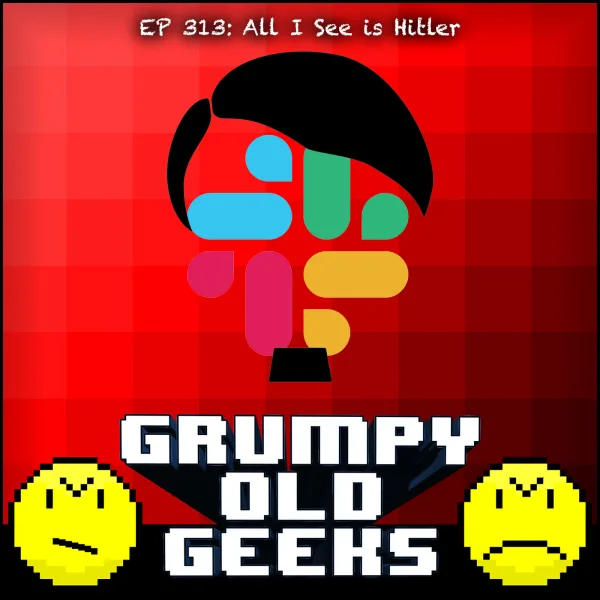
313: All I See is Hitler
The publisher’s audio length has changed since transcription. Ads may differ, so timestamps may be offset.
Summary
This episode of Grumpy Old Geeks covers social media trends, technology policy, online services, and Slack’s new logo. Jason DeFillippo and guest Joe Kerrigan also discuss security cameras, exposed data, phone privacy, and a range of apps and gadgets.
- The hosts discuss Star Trek: Discovery, the viral Instagram egg, and Facebook’s 10-year challenge.
- News topics include Microsoft’s Seattle housing loans, YouTube’s dangerous-challenge policy, and Tim Cook’s proposed privacy rights.
- They cover Germany’s ruling on Amazon Dash Buttons, an investigation into Tidal’s streaming figures, Netflix’s price increase, and a proposed EU copyright directive.
- The hosts criticize Slack’s updated logo.
- Jason DeFillippo and Joe Kerrigan compare home security cameras and discuss the Collection 1 credential dump and exposed Oklahoma Securities Commission records.
- They discuss exposed FBI investigation data, biometric phone unlocking, and government websites affected by the federal shutdown.
- An Airbnb guest’s account of cameras in a rental prompts discussion of camera disclosure and responses to vulnerability reports.
- Later topics include GoodNotes 5, voice assistants in cars, a robot hotel, and the Cranberries’ final album with Dolores O’Riordan.
Key moments
-
Streaming and social media
The hosts discuss Star Trek: Discovery, the Instagram egg, and Facebook’s 10-year challenge.
-
Technology and policy news
The hosts cover housing loans, video moderation, privacy proposals, online services, and copyright rules.
-
Slack’s new logo
The hosts criticize the design of Slack’s updated logo.
-
Security cameras and exposed data
Joe Kerrigan joins Jason DeFillippo to discuss camera storage, breached credentials, and Oklahoma’s exposed records.
-
Exposed investigation data
The speakers discuss Shodan and the possibility that others accessed exposed FBI investigation data.
-
Phone privacy and government websites
A ruling on compelled biometric phone unlocking leads into a discussion of government websites affected by the federal shutdown.
-
Cameras and disclosure
An Airbnb guest’s account of security cameras prompts discussion of complaints and vulnerability disclosure.
-
Apps and gadgets
The speakers review GoodNotes 5 before turning to voice assistants in cars and other products.
Full transcript
-
Grumpy Old Geeks. A weekly talk show hosted by Brian Schulmeister and Jason DeFillippo discussing the finer points of what went wrong on the internet and who's to blame. Welcome to Grumpy Old Geeks. I'm Jason DeFillippo.
-
And I'm a very exhausted Brian Schulmeister. Why are you so exhausted, Brian? Let's just say I'm not looking forward to summer vacation. I understand these things now. Are you being Mr. Mom? Oh my God. My kid got a flu on Sunday night and he has been home all week.
-
No school whatsoever because he's been contagious and sick and all of that. And it's been raining in Southern California, which means we haven't gotten out of the house. And before you say from other parts of the world, well, you could have just bundled him up. He was contagious. There was nowhere to take him. And taking your kid out in the rain, in the cold when he is already sick is irresponsible.
-
So yes, it is. It's been a very long week. Oh, poor baby. Poor baby. Okay. Well, let's move on to some follow-up. Let's do it. All right. Star Trek Discovery last night premiered with season two. Did you get a chance to watch it? No, because I've been waiting for it to premiere in Sweden.
-
Ah, well, see, you know what I did, Brian? What? I paid for CBS All Access for a year. Did you? Yes, I did. It would cost me like $66. And I got the entire year. I got the commercial version because I read the fine print for the non-commercial version. And it said, some shows may have commercials.
-
And I'm like, well, what the fuck am I paying for? That's not a non-commercial version. Exactly. So I'm like, you know what? I do have to pee sometimes when I'm watching the show. So I'll just take the commercials. So $66 for the year. So I am now, I am subsidizing Star Trek Discovery and Picard and a myriad of other shows.
-
They've added a lot to the catalog there. So I thought it was worth the spend. It's like $5 a month, you know. I haven't really looked at it yet, but certainly once Picard is up, I will gladly then pay for it. I can justify paying for two shows. Yeah, and they've got a Roku channel, so it plays like, you know, native on my TV.
-
So I thought it was an easy one. It saves me the time of going to Sweden. And I will say that the first episode is delightful. I enjoyed it the entire way through. I was smiling the whole time. I wonder if this means I'll dislike it because we seem to have differing opinions on this discovery so far.
-
Probably, probably. But I thoroughly enjoyed it. I, you know, I was like, I watched it at 11 o'clock last night because I'm like, I got to watch this for the show tomorrow. And I'm like, this is way past my bedtime. Because I usually go to bed at nine. And I was up till like midnight watching the show just so I could do this little bit.
-
Right. And so I'm sleep deprived. I got four hours of sleep. But you know what? It was worth it because, man, I'm loving the new season. Awesome. Well, I'm going to definitely be checking it out shortly, hopefully over the weekend. A little bit of follow up on the Egg, the Eggman on Instagram that became the most popular, liked photo on all of Instagram's history.
-
Recode is asking the question, is having the most popular photo on Instagram worth anything? We're about to find out. And then they did an interview with a bunch of people that do ad sales on the internets. And basically, they're saying that this could be a $250,000 single ad run on this account that has only one other photo.
-
Another advertising executive said it could sell for close to a million dollars because there's no there's no the normal rules around how an influencer can charge per follower doesn't apply to a viral sensation like the Instagram egg. And I personally have not followed up on this, but I hope boy, do I hope this is an old school Internet person that isn't going to cash out and is just doing it to do it.
-
I hope they cash out and retire and just get the hell off of Instagram. They're like, OK, we're done. We don't need to do this anymore. But what I did like in the article was there was one person that was the voice of sanity that says every second that goes by, that opportunity is closing. So they need to do whatever they're going to do.
-
They need to do it now fast. Yeah. Do it fast because it's an egg. Nobody cares about an egg. There's no follow up. So they whatever they're going to do. They need to do it yesterday. Yep. And over at Wired, there's an article about Facebook's 10 year challenge.
-
Is it just a harmless meme? And this comes back to what somebody posted in feedback last week saying, hey, maybe this is Facebook training their A.I. So they know, you know, what we look like 10 years ago and what they what we look like now, which is dumb. I got to say that is the I know what it's supposed to mean and all that.
-
It's like, OK, you get two pictures, one 10 years, one now. And then the A.I. can train on how people age. They already know that they have your pictures from 10 years ago. They probably have pictures from your baby shower, from your mom, so they can look in her womb and see what you look like. There's that there's no reasonable expectation that this is a thing.
-
I'm slightly with you on the on the this is a tinfoil hat thing. I did read. There's a lot of articles, a lot of articles, so many shocking, but some good points did come out of it. The main point being, well, this does kind of make sense for them in terms of it's getting a very simple, easy data set that you can track with a hashtag as opposed to having to actually use some real people to go through and go and figure out the dates on certain things.
-
It's because you can't just you can't just take a photo that was posted 10 years ago and automatically know that that's from 10 years ago. It could have been an older one. You know what I mean? So the only argument that I saw for this being a thing that maybe Facebook kind of crassly started themselves or whatever is the fact that it's the ease of the data collection.
-
This is making it super easy for anybody to do. And the real worry is it's not just Facebook, because if it's public, anybody control this stuff and anybody's facial recognition thing can get kicked up a notch here. Yeah, I just don't see it. I think this is an accidental meme.
-
You know, I honestly think it's just a viral thing that happened. It's but but the other article that I saw or the other point that I saw, and I don't even remember which article said it in, is the one upshot of this is people are starting to ask questions and people are starting to look at things critically and going, am I giving away something here?
-
Do I trust these people here? And that's what's actually starting to happen with this. So that's a good thing. OK, if you say so, I just don't see it personally. I really don't. I think it's I think this is just, you know, people like us who figured some things out and wanted to write some articles and get some page views.
-
Honestly, I guess I agree that that's what it is, too. But again, the idea that people are actually starting to wonder what's going on is a good thing instead of just blindly trusting social media. No, I'm cool with that. I'm totally cool with that. Yeah. You know, the smarter you are, knowing is half the battle.
-
All that shit. GI Joe, GI Jane, whatever. Now, Microsoft is pledging five hundred million dollars to tackle the housing crisis in Seattle, which is an interesting thing, which I'm good with. I'm good with, except for the fact that they're not like giving the money away. They're giving it as loans.
-
Some are some are like subprime loans. So, you know, below the normal normal rate just to boost construction costs and the rest are going to be at regular rate. So they're not really doing much besides being a bank, you know, which I thought was kind of lame. I'm like, yeah, you just give away the money.
-
Yeah. But you've got all the money in the world. But OK, at least they're doing something in the in, you know, reading all the different articles about this. I understand what they're trying to do. They're like, OK, we could spend five hundred million dollars and come up with like, you know, maybe eleven hundred units. But if we, you know, help the construction guys build new housing developments and help them jumpstart.
-
So if they get a loan from us, that will give other people the chance to give them more credit to build these buildings and then sell it. So they're looking at, you know, tens of thousands of units versus, you know, a small amount just for buying them out. A long term, a long term plan as opposed to a quick and easy fix.
-
Exactly. So I think it's very smart. You know, I was on the fence when I first read it and then I'm like, oh, that's kind of douchey. But then I'm like, OK, I read the rationale behind it and I'm like, that's it's extremely smart. Those people at Microsoft, apparently they got brains. Who'd have bunk it been around for a while? No. So who in San Francisco is going to take up the mantle for this, too?
-
Because they've been fighting about that tax that nobody wants to pay for for the homeless and building low, you know, low income housing. Not just San Francisco, I would say anywhere with these tech quarters, Silicon Beach needs it here in Venice and Santa Monica. There's no doubt about it.
-
Rents are through the roof. There is no low income housing. There are tons of homeless people living here and there's tons of money. Yeah, yeah. The problem with you, well, actually, it's the same problem as San Francisco is you have a very limited amount of real estate. So you've got to go up. You have to go up. And San Francisco is already used to going up.
-
They've got tons of high rises. But, I mean, this was something we talked about in San Francisco not too long ago. That's why I brought it up. And hopefully somebody will, you know, say, hey, that's actually a pretty good idea. Let's jump on that. So maybe the guys at Stripe who were so against that big tax because they got screwed on that deal will throw in their hat and say, hey, can we just roll back that tax and not make it the way it is right now?
-
And we'll give you some money as loans and then we'll figure it all out. Maybe it's a leveraging point for them that they can go forward with. We'll see. So, and YouTube is banning dangerous prank videos after the bird box fiascos.
-
I love this. I love this. So. I have questions. Okay. Okay. Hit me. Well, let me, let me explain it first. Okay. So what they're saying is, okay, we know that you guys love challenges and pranks and you put them on YouTube and it's fantastic. Okay.
-
But some of them are dangerous, like this stupid bird box prank that everybody's doing. The bird box challenge, which we've seen people crash cars. So I got to get a tattoo this morning. It is so stupid. But what they're doing is saying, okay, well, challenges that have a risk of injury or death, death being a major thing, they're going to start pulling them.
-
Right now. I'm like, okay, that's great. But if you can funnel your filters and your AI at stupid bird box things, why can't you do that with hate speech and all of the other things you're supposed to be filtering for that you can't seem to get your shit together with?
-
That's the thing that gets me. Yeah, well, that, okay, my two main points about this is the first is, is this just AI or are they actually going to have to ramp up real people looking at stuff to determine what, what is what, right? They're looking at tags. Is this, yeah, they're just looking at tags, which means next to nothing because it's very easy to get around that, obviously.
-
So you're not really increasing the amount of people looking at things. You're just kind of catch as catch can as it goes. And the second point that I make here is, isn't this explicitly admitting that you're no longer a platform? No, I mean, they have, they've, they've been, they've been filtering content for years.
-
I know, but it's, it's, it's time to step up now, YouTube, get rid of the hate speech. Mm-hmm. Yep. Get rid of all the other stuff on there that we all know is on there and is actually making you money. You can do it. It's such a ridiculously hard problem, though. Thinking about how much, how much video gets uploaded per minute, like 24 hours per minute gets uploaded there.
-
Which is insane. Yeah. So they have to have algorithmic machine learning AI to help figure this out. But if they can just say, I mean, honestly, all this is going to be, they're looking at hashtags. That's, that's all they're going to end up doing. If it says hashtag bird box challenge, it's going to get pulled. Pretty much.
-
That's, that's about it. Yep. And I found a great article over on time.com, time magazine, amazingly still a thing by none other than Tim Cook himself. It's called, you deserve privacy online. Here's how you could actually get it by Tim Cook.
-
He is standing up and, and just shouting at the stars going, we need legislation to stop this shit. Good. We're over it. I love Tim Cook. I love him more and more. I think he's doing a phenomenal job leading the charge on this and somebody has to.
-
And the fact that it's coming from basically the, one of the largest companies, one of the two largest companies in the world is a good thing. So keep yelling, Tim Cook, keep screaming. It puts some pressure on some of your cohorts in there. Yeah. I'm going to just read this real quick. He says last year before global body of privacy regulators, I laid out four principles that I believe should guide legislation.
-
First, the right to have personal data minimized. Companies should challenge themselves to strip identifying information from customer data to avoid collecting it in the first place. Second, the right to knowledge, to know what data is being collected and why. Third, the right to access.
-
Companies should make it easy for you to access, correct, and delete your personal data. And fourth, the right to data security, without which trust is impossible. You go, Tim. I mean, that's great. I mean, it's going to have to fundamentally change the entire principles on which our current modern internet of shit is organized.
-
But I'm down with it. This is what should be happening. Yeah. And he also goes after data brokers. It's like, okay, once you give your data to somebody else and then they sell it to a data broker, it's in the wind. It's gone. You have no recourse. You have no idea where it's gone. And putting these people on notice is part of what he is proposing.
-
And I love it. I mean, we need to do this. It's getting ridiculous. Yep. Who would have thought that we'd be sitting here in 2019 and it's Amazon or not Amazon. It's Apple and Microsoft that are kind of leading the charge on things. Yeah. I mean, it's a new world.
-
It's a brave new world. In the news.
-
Ah, Germany. They're so quick to make things illegal and it's so wonderful. They have made the Amazon Dash Buttons illegal. And the argument in this article is so should you because they're ridiculous. Amazon Dash Buttons have been ruled illegal in Germany for violating consumer protection legislation, according to Reuters.
-
I think that's Reuters. Yes, Reuters. Reports Reuters. For the uninitiated, the buttons allow customers to order products like laundry detergent with just the push of a button, which is a Wi-Fi connected device you can buy from Amazon for $4.99. So they get your five bucks.
-
You put a button somewhere. You press the button and it just reorders products for you. It's attached to a specific product. And that's that. I feel like a rat in a maze with one of those. If I had that in my that's one of the reasons I never bought one. I'm like, you know, the rat presses the button for the cocaine pellet. The rat presses the button for the cocaine pellet.
-
That's all it is. I need my Tide Pods. Where's my Tide Pods? Give me some more Tide Pods. Exactly. So, you know, we all thought it was kind of an April Fool's joke when they first announced it. But no, it's real. And they've sold quite a few of them. But the court is basically saying that you do not have price information. You don't know how much Amazon is selling that Tide for when you agree to buy it, when you hit the button.
-
And that's illegal. So, you can't have these buttons anymore. Bye-bye. So, what Tide, or not Tide. I'm stuck on Tide Pods. What Amazon needs to do is put a little LCD readout on there and show the price. That's it. And actually, I don't even, they shouldn't even just be able to show the price.
-
They should show if it's changed since the last time you ordered. That would be the correct way to do it. Oh, that's actually pretty good. I don't know. That would mean a bigger LCD screen, which means the Tide Pod, or the Amazon Dash buttons. I'm stuck on the Tide Pod thing. I don't know why you get it out of my head.
-
I know, you really are. You really are. It would be $10, you know, instead of $5. But the great thing about, I think most of these Amazon Dash buttons are bought by hackers who buy them and then just, you know, take them apart and then reprogram them to do different things around their house. Because there are a ton of cool tutorials out there of what you can do with these Dash buttons because they're pretty neat.
-
Yeah, I agree. Tide. I'm still, maybe that's why I'm stuck on Tide because I knew the next story was Tide. Tide is actually being investigated in Norway for their bogus stream numbers. Remember when we said that, uh, All internet statistics are bullshit.
-
Exactly. So they're accused of inflating their overall subscriber numbers from 350,000 to 1 million. But also, like, the numbers for the actual amount of streams that were pushed out for Beyonce and Kanye, the math doesn't add up.
-
As Judge Judy would say, it doesn't have the ring of truth. Every subscriber to Tide would have to have listened to all of those songs, like, on a loop for 26 hours to get the numbers that they're saying. So, yeah, Jay-Z, you might be in a little hot water up there in Norway.
-
That's, wow. It's like a Ponzi scheme for rich musicians. Yeah. I love this, though. Norway's National Authority for Investigation and Prosecution of Economic and Environmental Crime. That's a thing in Norway. I wish it was a thing here.
-
I know. I know. Wouldn't that be nice? It would be so nice. Oh, wait, wait. We don't have a government right now, so we're not even going to get anywhere close to that. That is true. Well, in unsurprising news, Netflix is raising prices across all of its tiers. The streaming plans are going up between 13% and 18%, making its largest price hike to date.
-
The lowest $8 tier will now cost $9, while the $11 and $14 plans will go up to $13 and $16 a month each. I don't know why anybody is surprised about this, because they haven't really raised their prices since they started spending billions, and yes, that's billions with a B, on actual content.
-
Yeah, like $6 or $7 billion a year on content. Yeah. So I have no problem with this. I'm fine with paying it. As long as Netflix keeps up the content. Yeah. They are, so they're creating all their own right now. If this was, you know, if they were still just stuck in the, we're licensing content from other people, and we're battling with Hulu, and Netflix has next to nothing, then I would stop paying for it.
-
But they've still got a lot of great content coming in, so they can afford that. And I'm okay paying $14 or $16 or whatever per month for the amount of stuff that I'm actually watching on Netflix, as opposed to CBS All Access. Yeah. No, I'm paying, I'm on the, I'm on the, like, the biggest tier. I'm on the four-person tier with the Ultra HD.
-
I'm fine with that, you know? Yep. And because the content does keep coming every weekend, there is something to watch on Netflix. And every week, there's at least one new comedy special, and I love their comedy special. So they need to keep that up. And, you know, I was getting tired of it for a while, but they've been reaching out to, like, international comedians, and it really is, it's worth, it's, you know, it's worth the price of admission.
-
It honestly is. It's still cheaper than going to one movie. That is very true. Honestly, think about that. Yeah. I'm going to go see Glass this weekend, and it is going to cost me more than my entire month of Netflix to go see Glass. So, you know. I mean, I think out of all the apps, other than Nickelodeon, because, you know, two-year-old, I watch Netflix more than anything else.
-
Like, the only reason I still have HBO is for Game of Thrones, which is starting up, and that's really about it. It's almost all Netflix for me, so. Yeah. Yeah, we'll see what happens to HBO's stock price when, I don't know, actually, or is HBO even publicly traded? I don't think so. I actually have no idea, but I'm not too worried about them, because they've got a lot of good shows coming down the pipe, including the Game of Thrones prequel.
-
So, yeah. They're ramping themselves up. Yeah, they have to. HBO's going to be just fine. Yeah, they're not going anywhere anytime soon. But, yeah, like, looking at the back catalog on HBO, it's just like, oh, really? That's it. But, hey, the Deadwood movie's coming, so I'll sign up.
-
I'll pay for that for damn sure. Now, I love this thing. Article 11 is the EU copyright directive that's going into effect, possibly. It's Article 11 and Article 13, and this is the one where they said that Google can't use any snippets of any articles in their SERPs, their search engine results page, as we called it, in the biz.
-
So, Google rolled out a beta version of what Google is going to look like if these things actually pass, and it is hilarious. I'm like, well played, Google. Well played. There's nothing there. It's just the name of the actual, it's like, you know, top articles, and it's just the name of the publication.
-
No photos, no text. Can't even pull the title. Nothing. Nothing. Nothing at all. And everybody over there is just like, oh, you're just being mean. They're like, well, this is actually what's going to happen if you pass this. So, would you like a taste of your own medicine before you actually vote on this?
-
And it's awesome. It is awesome. Well played, Google. Well played. And in poor Snap news, their shares fell 13% to 14% the other day after the, it's basically like a conga line of the executives walking out the door.
-
Dun-dun-dun-dun-dun-dun, snap, dun-dun-dun-dun-dun, snap, going out the door. Snap, yeah. I saw a really great graphic that showed like every high-level executive that reports directly to what's-his-face is basically, Spiegel has basically quit in the last six months. Yep.
-
Which lets you know how great a job he's doing over there. Yeah. It's amazing. How is he still there? How is he still there? Does he have like Zuckerberg shares where they can't vote him out? I'd imagine so, right? He's got to at this point because the company is not doing well.
-
Nothing is working. Everything is tanking. It keeps going down, down, down. But, you know, business economics 101, change your CEO. Mm-hmm. Get an adult. Get an adult in the door. And so I mentioned I have a Roku TV and I've got a Roku box in my bedroom too.
-
And if I'd have seen this, I'd have been up in arms too. But Roku actually let Infowars and Alex Jones onto their platform for about a hot second until everybody said, what the hell are you doing?
-
And, yeah, in the light of that turmoil, they pulled it immediately. Good. Good. This guy, you know, he can have his own website. That's fair enough. Well, that's even hard enough because I don't think any DNS providers are even giving him the chance.
-
Well, it's markets. It's free markets, man. You know, if anybody is welcome to pick up this guy and put him on their platforms if they want to, but do so at your own risk. At your own risk, yeah. And what we're finding out is people don't want him out there, right? That seems to be the case.
-
Yes. Here's the here's the statement from Roku. After the Infowars channel became available, we heard from concerned parties and have determined that the channel should be removed from our platform. Deletion from the channel store and platform has begun and will be completed shortly. So this is this is a case where delete actually means delete.
-
All right. Now, we've had a lot of talk about science recently. Sunscreen, eggs, coffee, bacon, blah, blah, blah. The latest one to come out is screen time. We've all been hearing about how screen time is horrible for kids and teens and it's just destroying their lives.
-
Researchers just published a thorough assessment in nature, human behavior on screen time and mental health in teens. And it turns out that on balance, screens don't seem to be harming them at all. That's including a whopping three hundred and fifty five thousand people. Researchers found that there is a negative association between screen time and teen well-being, but it is so itty bitty as to be practically meaningless.
-
Is itty bitty a scientific scientific term? Scientific term. Yes. A digital technology use at most accounts for a dip of about a half of a percent in the well-being of teens, putting it on par with the mental health hazard of eating potatoes. Potato time.
-
Potato time, kids. But three hundred and fifty five thousand, three hundred and fifty eight is a significant sample size. I have to say it is now. This is teens, not not toddlers and things of that nature. So doesn't seem to be too much of a problem.
-
So maybe one less thing to worry about until the next study comes out. Yeah. Until next week when it comes back out. So in in the Internet is just having fun with itself. News Slack has a new logo. And what a thing this is.
-
What a sight to behold. What's how this made it through one meeting, much less focus groups approvals. Oh, my God. So I was I was trying to save it for the show, but I couldn't help myself.
-
So I tweeted this. I tweeted this. I made it made a little graphic that shows how the negative space in the design and the boundaries of the new Slack logo. It basically is a swastika. Other people picked up on this, too. I was not the only one that found this. And it's not basically it just it is.
-
It is a swastika. Yeah. Yes. And I called it an ejaculating swastika because it looks like a spooge fest. I don't know what's going on with this. And, you know, when Slack started, Slack came out of the people who did Flickr and Flickr came out of a video game.
-
The video game failed. They created Flickr because the photo sharing service was better than the video game. Then once Flickr sold, then Stuart Butterfield got the band back together, except I don't think Katarina came with. And then they created another video game. And that video game sucked, too.
-
But what came out of that was the collaboration software that they used to build the video game, which then became Slack. Well, my friend Daniel Berka was with those guys because he's an awesome Canadian designer. And I love that guy. But he left. He took his money and ran.
-
He was the smart one. He's been traveling the world. He's like, yeah, fuck it. I'm out. You know, they need to get Daniel back because whatever this abortion of a logo is just needs to go away. I mean, when you tweeted it and I saw it and then, you know, obviously the app updated on my phone and I got the new logo.
-
Thankfully, it has not updated on my Mac yet. So I'm still looking at the wonderful old Slack logo that doesn't have any neo-Nazi incriminations whatsoever or spooge. Jesus, I really, I speechless. I don't know how this got through a single damn meeting.
-
Who the hell designed this? It's updated on my Mac and I have to look at it. And it's got a purple background. And yeah, it's just this little noisy thing at the bottom. And all I see is Hitler. All I see is Hitler. All I see is Hitler. So we'll see how this, this is going to play out because basically everybody on the planet is just like, what, what, what, what, what, what, what?
-
So, yes, my ejaculating swastika. Go check out my Twitter feed at twitter.com slash jpdef if you want to follow that. But yeah, I just, I'm gobsmacked. Utterly gobsmacked. This episode is sponsored by Molecule.
-
Imagine if your phone was the same as it was in the 1940s. This is exactly when the technology you're using to clean your air was developed. The last major innovation in air purification was in the 1940s with the invention of the HEPA filter during the Second World War. Molecule introduces a breakthrough science that is finally capable of destroying air pollutants at a molecular level.
-
Molecule's PECO technology goes beyond HEPA filtration to not just capture but completely destroy the full spectrum of indoor pollutants, including those 1,000 times smaller than a HEPA filter can trap. Molecule makes a meaningful impact for asthma and allergy sufferers. In a study of 49 allergy sufferers presented at the American College of Asthma, Allergy, and Immunology, Molecule's technology provided dramatic, statistically significant, sustained symptom reduction within a week of use.
-
The results have transformed lifelong allergy and asthma sufferers' lives. And one customer even said that she was able to breathe through her nose for the first time in 15 years. Molecule doesn't just have groundbreaking technology on the inside, but creates a complete and clean air purification experience.
-
From the materials used on the device, like its sleek, solid aluminum shell, to a streamlined filter subscription, where replacement filters arrive at your doorstep right when you need them, Molecule ensures breathing clean air is easy and seamless. Breathing clean air transforms the way you sleep, particularly for those who are asthmatic or allergy sufferers.
-
Since we're not immune to the air around us while we sleep, we're still susceptible to the allergens and pollutants in the environment. With Molecule, customers have reported feeling energized after the best sleep they've had in years. Molecule's claims on its technology have been tested and verified by third-party laboratories, like the University of Minnesota Particle Calibration Laboratory and University of South Florida Center for Biological Defense.
-
Molecule's technology has been personally effective and verified by science, but most importantly, it's been tested by real people. Molecule has already helped allergy and asthma sufferers around the country better cope with their conditions and significantly reduce their symptoms. So, for $75 off your first order, visit Molecule.com and at checkout, enter code GOG.
-
That's M-O-L-E-K-U-L-E dot com and at checkout, enter code GOG for $75 off your first order. Security? Ha! We're back this week with Joe Kerrigan, Senior Security Engineer with the Johns Hopkins University Information Security Institute, sitting in for Dave Bittner, who's going to go get his little toothy fixed because he got a cavity.
-
Joe and Dave co-host the Hacking Humans podcast where they take on social engineering. Hello, Joe. Hi, Jason. How are you? I'm doing fantastic. So, I got a little bit of follow-up from last week. We talked about what kind of camera that you can have in your home, a security camera, that you can upload your data to that is not in a proprietary cloud.
-
And it dawned on me that I have a system that I bought from Amcrest. These are these Pro HD cameras. They're 1080p. I have four of them, and then I have a garage camera, like a static-mounted outdoor camera. And you can put SD cards in them.
-
But also, you can do things like upload to your NAS, like my Synology. I forgot. I actually have licenses to upload the video from those cameras straight to my Synology. And it comes with a nice interface. You can actually FTP. Yeah, I saw that.
-
You can FTP the files to a remote location. Yeah, I'm just hoping it's SFTP and not just regular FTP, because that would be kind of scary. Yes. Like, who uses FTP anymore? But there are a bunch of different options. But yeah, these cameras are pretty robust when it comes to being able to use your video feeds as you like.
-
Right. And I like that part. What I like about it is, even if you do use the cloud service, if you check out their privacy policy, they say how we use your information. It says, we use your personal and device information solely for the purpose of delivering services to you. And when it comes to who owns your information, they're very clear on the fact that you own the information and you can delete it at any time.
-
Yeah, you put this in the show notes and I went and looked at it. And this is one of the best privacy policies I've ever seen. It is so crisp and clear and easy to read for humans, not lawyers, because lawyers aren't human. Yeah, it's very nice. I like it a lot. Yeah. And the thing about these cameras, they're really good cameras.
-
You know, I got the pan and tilt one so I can hang them and go in with my web interface or my iPhone interface and pan around and do it. Their cloud service is god awful. It's got one of the worst interfaces I've ever seen. And it's really slow. So I paid for it for about a year.
-
And I was just using those. And then I ended up moving to the Logitech Circle camera system because the Logitech web interface is so much better. Their app is so much better. But you don't get the same options for where you store your data. It's Logitech or nothing. Right. But the interesting thing about Logitech is they give you 24 hours free for all of your cameras.
-
So if you have your cameras up and you get broken into, you can just run to the website, pull the video down, and get it without having to pay a monthly subscription, which I really liked. And I now pay for all of my cameras to be on their cloud system for 14 days, which still turns out to be less than the Amcrest system, which was just, like I said, god awful.
-
All of the software that comes with Amcrest is terrible. All of their apps are terrible. It's pretty costly, too. It's not cheap to keep things on there. Their price model is time-based. Yes. So how long you keep it up there. But they're clear about what delete means. Yeah, they are.
-
It means it's deleted. It's gone. We don't keep it. Yeah. I'm going to put these up in my house, in my studio, and everything is a backup because the fact that it does have SD cards in it, and you can just throw in a little micro SD card, like a 64-gig micro SD card, which you can get for like $40 now.
-
And all of those. And that will give you like two weeks worth of video. And then it will just auto cycle through and delete the old stuff. Well, that's cool. I really like that. So then, you know, if somebody breaks in. Yeah. They're really nice, and they're affordable. That was the one thing that I got. They're like, you know, $70, I think.
-
For a full pan and tilt camera with, you know, it's motorized, night vision, the whole nine yards. It's HD. Yeah. Yeah, it's 1080p. No 4K, but it's good. Hopefully, the video is useful in the event that you need to turn it over to law enforcement. A lot of times, the video is not useful because you can't really make out who it is.
-
So you hand it to law enforcement, you're like, I can't use this. Yeah. I haven't found a really good 4K one, which is what I really want for like the outside of my house so I can get license plates. License plates are what I really want when people try and break into things like, oh, my roommate's car multiple times.
-
Yeah. You know, that's the really hard part. I've got a Logitech Circle 2 outside my garage right now, and it does give you good video, but you still can't make out the license plate with night vision. And that part kind of sucks. And you think you'd be able to get that with a 4K camera? I'd hope so.
-
You know, I'd hope so. Or maybe I'll just like stick a license plate reader in the bushes and do that. That would be better. You know, they have these automatic license plate readers that law enforcement carry around with them everywhere now to track where we are, right? Yeah, I'd track everybody else.
-
I want to track everybody else that comes down my street. Yeah. Maybe you can get a hold of one of those and just plug it in and log all the license plates that go by. Our workaround without having to be able to do the license plate reader was these Logitech cameras that I have are USB powered. So you plug them into a USB brick that then you plug into the wall, but they work on power bricks.
-
So I took a Logitech Circle 1 camera and put it on the dashboard and plugged it into an anchor power brick every night and would just leave it on the dashboard. So if somebody broke in the video, exactly, because the video is pumped into my Eero system, which has enough like mesh network in the neighborhood here where I can, you know, I've got enough distance to the cars.
-
So I'm getting video from the camera all night long. So if somebody broke in, I would at least get their panicked face when they looked up and saw the camera, even if they stole the camera, it wouldn't matter because I would still have them. Yeah. Yeah. And those cameras are like a hundred bucks. So it's well worth it just to get that video.
-
I mean, I could make some good YouTube money on that. Right. Seriously. So let's talk about the news of the week here. Alrighty. What do we got? This collection one data breach that everybody's talking about the 773 million record big dump. This is from Troy Hunt.
-
He, uh, he found this up on some drop site and downloaded it and started going through it, uh, and then normalized it to some extent, uh, took out all the duplicates and, and produced this, um, or he has this, he hasn't really shared what he has.
-
What he's sharing is the hashes of all the passwords that he's collected over time. Right. There are emails associated with these, with these, uh, passwords that are broken. So if you are a hacker, if you were a malicious actor, you could take the email and the broken passwords and hope that people were reusing their passwords and start trying to log into different services with these usernames and passwords or emails and passwords.
-
Yep. That's the, that's kind of the gist of it. And he put it into have I been pwned of course, which is what he does. I love that site. Great service that he does. Oh yes. Fantastic. Yep. So yeah, crabs on security came out this morning saying that this is an old dump, not a new thing.
-
And it's part of a, a whole host of, you know, breaches that you can buy pretty cheaply. Yeah. These are, these are out there for you to get on the, on the market. And it looks like what this guy is doing is just aggregating the data. The guy that's selling this, uh, collection one, he's aggregating data from previous dumps.
-
Uh, Kreb said some of these things are two to three years old, uh, that doesn't mean they're not good for credential stuffing. Some people don't change their passwords. And if you reuse passwords or you pick weak passwords, that's still valuable in the credential stuffing attack. Oh, definitely. Yeah, no, it's still, still valuable data, but, uh, it's not, it's not a new thing.
-
It's like this guy is just going around getting all the breaches off the dark web and put them together and just packaging them up. He's like, you know, he's a curator. He's, he's basically a very evil curator. He's a value added reseller. Exactly. His value is I've, I've saved you the trouble of having to go out and find all these things yourself.
-
Yes. Yes. And I love, there's a little graphic on, uh, Krebs where he talks about how everything basically comes back to email. Right. If your email is hacked, then basically you've just, you know, you lost the farm. Yep. That's kind of it. Absolutely. And that's another case to be made for a using a password manager, which we have been saying for six years.
-
Right. So if you haven't done that yet, come on. That's one of my points of evangelism. Get on the password manager train. It doesn't matter what you use. Just use it. Yep. Use it. Don't reuse passwords. Right. And also when you can, please, pretty please with sugar on top, use two factor.
-
Yes, absolutely. That will mitigate a lot of this because I, you know, I put in my passwords that, uh, my old passwords that I used to use before I found one password. I found religion and a lot of them were in, in the database. Right. Like, okay, that's good. So then I went into one password and I searched for all the times where I still use that password.
-
And fortunately, because I'm a nerd and I don't have much to do on the weekends, zero. Zero. Excellent. Zero showed up. Yeah. Very good. I love that part. That's excellent. And it could work. And if you use one password, they have a feature called watchtower that actually pulled from the, have I been pwned database and shows you all of the accounts that you have that were not even were, but possibly could have been affected by any breach that has come out.
-
It's like this, this data might have been. So the watchtower service searches the pwned password database and lets you know if your passwords appear in the database, which means you shouldn't be using them because when someone gets a password hash, the first thing they're going to use is a password list.
-
And now they're probably going to use this list and they're going to, they're going to find it fairly quickly regardless of how secure the hashing algorithm is. Yeah, definitely. I mean, if you know anybody that's still using MD5, take them out back behind the woodshed and shoot them, please.
-
Do something mean. Yeah. I would say kill their cat, but that's, that's not fair to the cat. Yeah. That's right. The cat didn't do anything. No. But yeah, so all in all, this is, it's kind of a tempest in a teapot because everybody's thinking that it's this huge thing.
-
Yeah. It's not new information. It's just a, you know, you can see how aggregating information can become apparently more dangerous. Right. And I'm looking at this screenshot he has and collection one was 87 gig. Collection two is 526 gig.
-
Much bigger. So much bigger. And, you know, bigger doesn't always mean better, but you don't know which actual breaches are in those collections. You know, I'm almost tempted to just go shell out the money and buy them just so I can take a look at them. But I don't know if that's illegal since I'm not a security researcher.
-
Would that, would that be considered illegal? I don't know. I'm not a lawyer. Hmm. That's a very good question. Yeah. I don't know. I mean, I'm using it for news gathering purposes, but I don't know if in a court of law I could call this show news. I think you could call it news in a court of law.
-
Yeah. I think you'd be protected under the First Amendment. And this information is available publicly to anybody that's willing to pay for it. As long as I don't reshare it. Yeah. If I don't reshare it or actually use it, so I wouldn't be under the, you know, computer fraud and abuse act. Yeah. I don't know. I would, I would definitely talk to an attorney before going out and buying that.
-
Yeah, that's true. Except I can't afford an attorney. I can afford the breach, but I can't afford an attorney. Right. That's, therein lies the rub. So anyway, everybody don't be too worried about this, but definitely get your password manager on and change your passwords if you use the same password everywhere.
-
Absolutely. Don't do that. Don't use the same password anywhere. That's just asking for everything to go, go south on you. It's, it's a terrible idea. Yep. All right, moving on. What you got? Uh, Oklahoma, not okay. Okay. The Oklahoma Securities Commission had left a three terabyte cache of data exposed and unprotected on the internet.
-
And this information included seven years of FBI investigations in the state. Oh my God. Isn't that fantastic? Three terabytes. Right. Was this an unsecured AWS bucket? I think it was inside because the story, the story from, uh, the Oklahoma, um, state government is that there was a firewall configuration or an installation of a firewall that wasn't configured properly.
-
Uh, and the researcher who found it, found it after it had been on showdown for a week. So, um, I think it's safe to say that any of that information has now been breached out to somebody. I'm sure somebody else has it. Uh, the researcher probably wasn't the first one to find it.
-
Yeah. That's crazy. Cause, um, I went, I met Dan Tentler up in Canada when we went to the fireside conference and he was telling, I mean, he's a showdown master. Right. And he's like, I can scan the entire internet in about two hours now with the computing power I have just doing port scans and things like that.
-
And then he went into his showdown spiel and there, there's just so much you can do with showdown. I, I want to meet the guys that built that because man, that is a useful tool. It is fascinating, isn't it? Yeah, it is. I really want to dig into it if I, when I have the time, but I fear that I'm going to go down the rabbit hole when I go in and dig into showdown because that is really my jam.
-
Yeah. You, you will, you will, uh, you'll get distracted by anything on that site and go, let's look at this. Let's look at this. It's, it's, it's an amazing site. You should go look at it and, and, and play with a little bit and just see what's out there. Yeah. It is fun for an afternoon. Even if you're not tech savvy, just go check it out and just start doing some searches and look around and then you will just see some things that will blow your mind.
-
I'm still trying to find out if any of my security cameras show up there, but it may cost you a good night's sleep or two, but I could just get this. Yeah. Yeah, you can. So what do you think about this seven years of FBI investigation thing though? That is really, uh, yeah, that's, that's a lot of, uh, a lot of data that, that was probably sensitive.
-
It probably has some kind of financial impact to some of these companies. Um, you know, I think ATT was listed in there as being part of some investigation. I don't know how, how they were involved, but, um, probably cooperating and giving everybody their, everybody else's cell phone info.
-
They're good at that. Uh, what's great about this is nobody's talking about it. The, the FBI is saying we're not commenting on it. We can either confirm or deny anything. And the, uh, Oklahoma state government saying, we're not going to comment on an ongoing investigation. Did you ever watch Hogan's heroes? Yes.
-
I know nothing. I know nothing. Nothing. Oklahoma. Oklahoma. No, I, I'm just, yeah. I'm wondering who has this data. Like, you know, even this, this one researcher found it, but you know, somebody else has to have it.
-
Somebody else has it. Somebody else has it. I can almost guarantee. Yeah. If it was on show Dan, somebody, somebody else got it. Cause there's so many people trolling that site all the time, looking for things just like this. Exactly. So I really want to see that FBI file. I really want to see that FBI file.
-
And in big news, uh, I don't know how this is going to play out, but, uh, a judge ruled that feds can't force you to unlock your phone with your finger or your face. Yeah. I heard Ben Yellen talking about this on the cyber wire. Yeah. And it's an interesting thing because up until now they could use your biometrics, like your, like your thumbprint, even if you're dead to unlock your phone.
-
Yeah. And this, this changes the, um, the, the stance of it because they're saying it goes against the fifth amendment, right to not incriminate yourself. Yeah. They're comparing it to, uh, it's the same as a password, which they've already ruled. You can't, uh, you can't mandate that someone give up their password.
-
Um, and even though your face or your, your biometric stuff can be used in other ways, since you're using this as essentially your password, uh, this court has ruled that you can't, um, you can't be forced to do that. You can't be compelled to, uh, essentially testify against yourself.
-
They're saying it's the same as, uh, as giving up your password. And cops everywhere rolling over in their grave with this one, right? Because man, that, that takes away so much investigative power from them. Um, yeah, that's going to be what they say. I don't know that I agree with that.
-
Oh, I don't either, but that's what they're going to say. Right. Yeah. You know, you go back to the, uh, to the case of the, of the San Bernardino shooters where they, the law enforcement there, I think it was the FBI was trying to get their phone unlocked and Apple wouldn't help them. Uh, and then when they got the phone unlocked, there was nothing of value in there because the phone that had the valuable information was the one they destroyed.
-
So I think this is a good ruling. Honestly, I agree. I'm, I like it with it. I like it a lot. Anytime, anytime that, uh, that a court rules on the side of, of privacy, I'm happy with that. Absolutely. Absolutely. Now, since we don't have a government right now, things are kind of going cattywampus.
-
And I found this over at tech crunch. Yeah. And it's a list of all the federal websites that run on HTTPS who have a security certificates that are going to expire soon. And since nobody is home to call up the registrar and redo that certificate.
-
Oh my God. I cannot believe this. This to me seems like an essential operation. Doesn't it? Yeah. This should be covered. Right. It should be covered. It absolutely should be covered. But for some reason, somebody doesn't view this as an essential operation of government. And, uh, and they're just letting it go.
-
They, they should not be doing this. Hey, but we can get burgers for a sports team, but we can't get security certificates for, yeah. Well, I'm looking here, uh, irsauctions.gov, irssales.gov, malwareinvestigator.gov, which is the FBI's malware analysis site.
-
You'd think that those guys should be able to get their certificate updated. They will be prioritizing this as a, uh, as an essential, essential piece of duty. Uh, you know, last week I was, uh, uh, on the cyber wire podcast with Dave and I wanted to look at the new NIST standard for passwords, but the NIST page just says we're shut down.
-
Oh, you gotta be kidding me. And that's it. That's all they said. Yep. I, I, I mean, why would you shut down? It's not like you're paying GoDaddy like 599 a month. You have your servers. They should be up. They should have been paid for in advance. You know, why, why would you take down a website during the shutdown?
-
It makes no sense at all. This stuff is already paid for. It's not the actual NIST page. It's the, uh, cause the NIST page is up and running it right now, but the, the page that had the, uh, the standard on it. So I sent you the link to the NIST page that you were, that I was talking about earlier.
-
It's, it's where you download the standard and it says, uh, right on it that, uh, due to the fact that the federal government is currently shut down the website pages.nist.gov will be unavailable until further, further notice. Wow. I, cause yeah, webpages cost so much money to actually serve.
-
Right. So, you know, there's, there's nobody there, but there is a computer serving this page out and, uh, but it's not giving you a standard on the passwords, which was, uh, actually a pretty good update to the standards. I think. Yeah. That, that, that standard change because they had before, like you have to change your password every 90 days.
-
That was removed. Wasn't it? Yeah, it was a couple of different things. Yeah. It was, uh, first off, uh, that was a, that's probably the biggest thing that you should not compel people to change their passwords frequently because that causes them to pick a weak passwords. There's a lot of research that, that points to that. Uh, there was a Virginia tech article, uh, back in the spring that said, if, if you practice, you know, just augmenting your passwords slightly that I can usually guess your new password in less than 10 guesses.
-
So, um, the, the, the, the suggestion that you don't force people to change their passwords is born out of the fact that if you do force them to change their passwords, they're going to take the easy way out and pick a password that's very similar to the last one. Yeah. They're just going to change one number or one letter or just add in like a different, like control character at the end.
-
And it's essentially like not changing your password. Yeah. Yeah. That's great. That doesn't mean that individuals shouldn't change their password. Uh, if you have a policy of, uh, changing your password on, you know, a semi-annual or annual or even quarterly basis, then, uh, you're going to be better protected against the unknown breach than someone who doesn't.
-
And moving on over at wired, they have a great story about the millions of dollars that Silicon Valley spends on security services for executives and CEOs and all of the high level people that you definitely sometimes want to go out and kill. Yeah. Uh, Mark Zuckerberg.
-
It's interesting. I think that this, uh, that there's a direct relationship between how much the CEO is hated and how much money they have to spend on them. For example, Apple only spends $300,000 on Tim Cook, but Facebook spends 7 million on Mark Zuckerberg.
-
And it's expected to spend 10 million next year. Right. Yeah. Zuckerberg. And Larry Ellison, uh, is only 1.6 million. Ah, man. That's, I think in the old days, I think if you adjust that for inflation back in the old days, he probably spent a lot more because everybody hated Larry Ellison back in the day.
-
Yeah. I was about to say, I don't think they're spending enough on Larry Ellison. Yeah. No, he's, uh, he's, he's a weird, he's a weirdo. He's a weirdo. And now, now that he's on the board of Tesla, I can see them even upping that even more. Yeah. But I wonder how that's going to go.
-
Yeah. And they got 600 grand for Sundar Pichai, which is, you know, okay. Yep. 300 grand for Eric Schmidt. Who cares about Eric Schmidt? He left. Yeah. Why are they still spending money on him? He's writing crappy books now. Probably part of his, uh, separation deal. His golden Kevlar umbrella.
-
Right. His golden Kevlar. That's what he got. Golden Kevlar. So all in all, this is just a, it's a crazy thing. So if you see Zuckerberg on the street and you think about like, oh, I'm going to go give him a piece of my mind. I'm sorry, but he's surrounded by ex-Massad agents who will basically break your bones.
-
You will learn Krav Maga the hard way. Yeah. On the, on the other end. Yeah. That is, that's a lot of money, but you know, I, I guess, you know, if you're, if you're a high profile person like Mark Zuckerberg and in the truth of the matter is with all the, all the terrible things that Facebook has been outed for recently.
-
I don't think this is a bad investment. I mean, his personal safety probably is a priority. I don't think Beyonce even spends that much. But, uh, you know, Beyonce is, is loved by people. Uh, and that's kind of my point. You know, I think Mark Zuckerberg is, is, uh, and, and even Sheryl Sandberg, who's second on this list with 2.6 million.
-
Um, you know, they're, they're both right now in, you know, constantly being, uh, targeted in the media for another, another problem with Facebook. Oh, look how Facebook is, uh, is violating our privacy again. Uh, so that's, that's why I think drives this.
-
I wonder how much Alex Jones pays on security. I don't know that guy. I, I just, I don't understand that guy at all. I don't get him. Yeah. Uh, you know, I, I listened, I've talked to people who, who listened to him from a humorous standpoint and, and, and laugh at what he says, but he, he has followers, you know?
-
And, and he talks about like crazy conspiracy theory stuff. It just, I, I can't, I can't wrap my head around it. Yeah. See, that's why you're on the show. Right. Because if you could wrap your head around it, we wouldn't invite you on. That's good. This is a self-selecting sample.
-
Right. Yeah. Is what I'm saying. It's like flat earthers, you know, all these other conspiracy theorists, but the main one that irks me the most is flat earthers. I, I can't abide a flat earther and I, I seem, it, it makes me crazy just even knowing that they're out there and that they're serious.
-
Oh, they're serious. They're serious. Very serious. There was a, there was a time when somebody was going to fund a reality TV show and it was going to pay flat earthers to go find the edge. That's what they were going to do. It's like, okay, you have a million dollars. Go show me the edge. Yeah. Let's, that's it.
-
Let's find the edge. That would be a great thing. A great thing to do. I would. Yep. If that was a GoFundMe page, I'd give them 10 bucks. Definitely. And all I can think of is my dog chasing his tail every day. Right. It's like going in circles. It's like, ah, it's about as effective.
-
Yeah. So finally, I've got one last article here from JeffreyBigham.com. This is a guy who went to an Airbnb and there were security cameras in the Airbnb. And he claimed that there was not enough disclosure from the, the renter of the Airbnb because so he walks in and is like, oh shit, there are cameras here.
-
What's going on? And he didn't even notice them for a day. Right. But since they were in the picture that they posted on Airbnb of the actual unit, Airbnb came back and said, well, that, that constitutes disclosure because it's in the, it's in the photograph. Right. Well, so he writes an article about how Airbnb screwed him.
-
And then he got bad reviews from the actual owner of the Airbnb because he went in after a day when he noticed him, he disconnected all the cameras. Okay. And said, no, I'm not going to be right. No, no, no, no. The owner says now you're tampering with the systems of the house, right? It's like unplugging the air conditioner.
-
And once his article got traction, the only way he got any response from Airbnb in the proper way is because he publicly shamed them. He got traction from his article and then Airbnb came back and said, no, we were wrong.
-
We're sorry. Blah, blah, blah. Yeah. You got caught Airbnb because most of the time they're just like, yeah, who cares about you? Oh, wait, I have a platform. I have a megaphone. A lot of people care about you. Now we care about you too. Exactly. Exactly.
-
So I thought that was just a ton of fun. You know, we have this guy just outed him. We have the same issue when we do vulnerability disclosure here. I'm responsible for all of our vulnerability disclosure. Our policy is that we are going to notify anybody that's responsible for something when we find a vulnerability and then we're going to go public with it after some period of time.
-
Our default period of time is 14 days. Right. Oh, that's short. Very short. But there's a reason for that shortness. It's because the first time we said it's 90 days and we didn't hear anything back from the company. So if a company goes, whoa, whoa, 14 days, that's not enough time.
-
Right. We say, well, how much time would you like us to give you? Right. And whatever they ask for, we'll give it to them. You know, if they say we need 90 days, we need 120, that's fine. You can have a reasonable amount of time to fix this problem.
-
But we tell them 14 days because we don't want to be bound to sit around and sit on our hands with a vulnerability to an honor to a non responsive company. I totally get that. So this is the same kind of thing. Is this this company comes in? You know, I won't name the company we had this with, but I disclosed a bunch of a bunch of vulnerabilities to him.
-
And then the professor who was responsible for the research on the vulnerabilities was was being interviewed by by Bloomberg and Bloomberg contacts the company and goes. Johns Hopkins says they can't get you to respond appropriately to vulnerability disclosures.
-
And then we got their attention. And now now that company has a bug bounty program that we actually work with them to develop it. And and now they have a defined process for submitting bug bounties. But until the point is the same here with these Airbnb folks and with any company that you deal with, they will not move unless you motivate them to do so.
-
And the seems the only way to motivate them to do so is by embarrassing them. You can either strong arm them financially or you can strong arm them with public shaming. That's pretty much at bad press or a bunch of money. Those are the only ways. They're not going to do it of their own accord. Nobody's going to do it of their own accord because the people in the C-suite don't get it.
-
They don't get it. Their IT department is probably tearing their hair out going, we need to deal with this. Right. And they're just like, it's a it's a rounding error on our part. We don't care. Right. We don't care. But once it shows up in the paper, then they're like, how could you let this happen? And then the IT guys get blamed and then it just spirals down from that.
-
Yeah. It's a it's a vicious cycle. But anyway, yeah, this guy, he finally got his his comeuppance with Airbnb. Hopefully his negative review was reversed. He doesn't say that in the article, but they did refund his stay. So he did get his money back.
-
OK. And once once he got his money back and I give this guy tip of the hat, made a sizable donation to the EFF. Ah, good for him. Good on you, man. Good on you. That's the way to do it. Support the EFF. Those are those are our guys. Joe, thanks for stopping by and filling in for Dave and Brian, who just could not be here today.
-
I really appreciate it. I know that they have things to do that are so much more important than doing the show. So it seems to me like their priorities are a little out of whack, Jason. I do believe so. I do believe so. Dental hygiene and child rearing. Come on. This is a podcast podcasting to do.
-
Seriously, seriously. Well, you're welcome back anytime, Joe. It was a pleasure having you. It was my pleasure being here, Jason. Apps and doodads. I got a great update this week on my iPad, which makes me so supremely happy. Good notes is one of my favorite iPad apps.
-
I had good notes for there were some issues with it. There have been issues with it since it came out with the fact that you can't change like the color of the paper and stupid things like that when you're writing it down. But if you have an Apple pencil and an iPad, good notes is the the go to note taking app. It is fast.
-
It you know, there's almost no lag when you're drawing and writing and doing stuff like that. Good notes five came out and I have to give these guys some of the I give these guys the best kudos and credit in the world. If you're not a good notes owner already, you can go buy good notes five for eight dollars.
-
Eight dollars is a steal for what this app does. But if you own good notes for they figured out a way using bundles inside of the iTunes store that I can get good notes five for a free upgrade. I got it for free. Yay.
-
It's cool that that somebody actually figured out how to do that. That's very nice. And that they that they did it. So I downloaded it. I tried it out. The thing about good notes five. I mean, there's tons of new stuff in here. Tons of new stuff. But the searching on handwriting is otherworldly good.
-
My handwriting is terrible. I can attest to that. I picked up everything that or it picked up everything that I that I wrote down and I was even just writing fast, even trying to fool it. It is so good that it just picked up every single word that I tried to search for afterwards.
-
It's an it's incredible. So if you're a note taker, if you like to write notes out longhand and don't want to carry around a pad and paper, good notes is so cool. And it's got a bunch of other new features. It is a I mean, even if you don't have it, eight bucks is a steal for this app.
-
This should be a fifty dollar app. As far as I'm concerned, it almost made me want to go out and get the new iPad just because I want my 12 inch iPad so bad, but I refrained because you bought a drone. Now, I also have my privacy dot com card linked to my Amazon account now, which has spending limits.
-
So I could go turn it off and do all that stuff. But I'm sticking with the plan. I'm sticking with the plan. I only have so much money I can spend on Amazon per month and and also on Apple and things like that. So I stayed away from the new iPad, even though it's killing me because I want it so damn bad.
-
But yeah, if you're a note taker, good notes five for the iPad and it and it syncs with the iPhone all over iCloud, stuff like that. So you have your notes in both places. It is so awesome. Excellent. Now, I ran across a good article over on Recode. The future of voice assistants like Alexa and Siri isn't just in homes.
-
It's in cars. The argument here is, of course, that cars are an even bigger market for voice assistance. Some 77 million U.S. Adults use voice assistance in their cars at least monthly compared with 45.7 million using them on smart speakers, according to a new survey from voice tech publication, voice bot dot AI dot AI.
-
So voice tech has been around in cars since 2004 when IBM launched a voice controlled navigation system in Hondas. Cars are arguably one of the best case uses for voice technology since driving prohibits. And this is one of those things that kills me about society because we know this is illegal, but everybody's doing it anyways.
-
People from using touchscreens or their phones. So you can argue that voice assistants are already in your cars because they're on your phones, but you're not supposed to be using your phone. You're supposed to be driving. Yeah. Oh, you need it built into the dash. And of course, what all the automakers have been doing so far is just putting touchscreens in the dash.
-
No, you're not supposed to be doing that either. You're supposed to be driving. So, you know, everybody's kind of going, this is a huge market. Where are they? And speaking of that, where the hell is the Echo Auto that I've ordered that I've preordered or I've signed up to be interested in?
-
I've gotten not a single email about it and I check the page and it still says nothing. I saw an article later, like early this week. I think 21 million people have signed up for the pre-release of the Echo Auto. I think they're overwhelmed. It's an absolute no brainer. Where every time I'm driving, even just like five minutes to go pick up my son from his school, I'm like, why don't I have this?
-
Why can't I just say start playing some music or start playing a podcast? This is ridiculous that I don't have this here. I need this here more than I need it in my house. Okay, Louis CK wireless on a plane guy. It's like, I want to be able to talk to my car like Kit. That's what I want.
-
I want Kit and I want it now. And why don't I have it? Because I'm so damn entitled. I want to be able to talk to my car. Yes. Yes, I do. And it's safer. By the way, whoever, I don't know if the guy who did the voice of Kit is still alive, but Amazon, Amazon needs to be finding that guy right now.
-
And that guy needs to be the voice of Echo Auto. By the way, why is that not an upsell for all of these voice devices? Because I remember back in the day, I close your ears, millennials. This is old school stuff when you would get GPS devices, you could buy and download voice packages like Darth Vader and things like that.
-
And it was awesome. Why don't these devices have that? Tom Tom is the one that did the Darth Vader one. Yep. Every time that every time you'd go off route, he would just say, I find your lack of faith disturbing, which is worth the price of admission right there. It's the best. And I totally associate that with Hawaii because one of the first trips I took with my wife before she was my wife was to Hawaii and we brought my navigation with me and it had the Darth Vader voice.
-
So I remember driving around Kauai being told, you know, I've lost your faith, blah, blah, blah. It was the best in the breathing and it was amazing. So you are missing out on a huge opportunity. You could afford the licensing. Get on it. Yeah. I mean, God, I would spend twice as much if Kit would be in my in my truck.
-
That would be so awesome. Totally. So in moving on to smart things that we may or may not need. We knew this was going to come, but Nike has officially introduced its first self-lacing basketball shoes. The Adapt BB. Yes. Straight out of Back to the Future. These new sneakers are designed to provide a truly customized fit for every basketball player, according to the company.
-
And thanks to a power lacing system called Fit Adapt that can be adjusted manually with buttons on the shoes or with, of course, an app. You have an app for your shoes. Well, you do now. And of course, because of all this, you have to you have to charge your shoes.
-
So they come with a wireless charging mat because you now have to plug in your shoes along with everything else. So, you know, I they have some really interesting technical reasons that why this may be of interest to really serious basketball players.
-
But I doubt it. So, yeah, yeah. No, I'm sorry. No, no, no, no, no, no, no, no, no, no, no, no. Yeah. So there's that. And hat tip to friend of the show, Mike, who just sent me this this morning. I actually am kind of I wish this would have been around when I was a kid.
-
Teens launch Uber Eats for condoms in bid to beat embarrassment. Three teenagers are hoping to combat the embarrassment involved in buying condoms from a store. And now this is in New Zealand. Auckland, 18 year olds, Jamie Martin, Harry Copeland and Isaac Mercer have set up an online business that delivers the contraceptives right to people's doors.
-
It's called Package. Clever. Clever. Very clever. It was sparked by conversations that highlighted young people's reluctance to buy condoms in person. I think this is a genius idea. It's quite smart, but it does not address what happens if your parents answer the door and open up your package. Exactly. Because that is going to be even more embarrassing than the person you don't know down at the Rite Aid.
-
Here's the deal, though. You're still going to have to look the Uber driver in the eye. You know, that's that was always the embarrassment when you're buying condoms and you go up and it's the old lady at the at the drugstore. And, you know, you slide up your Trojans and then she's just like kind of like looks down, looks back up, looks down, looks back up at you and then kind of gives you a wink.
-
And it's gross. It's like, yes, I guess what they really need to do is they need to move to package drones or package bots, package bots. Oh, God. Oh, man. I what's what's this world come to? You know what? Buy a buy a tub of them on Amazon for like 10 bucks.
-
You're all good anyway. But I guess. Well, actually, yeah, that's when we need the Amazon drone, because if you need it right then, then, you know, and honestly, absolutely positively has to be there right now. And how many times have you been in that situation where it's like it's going to happen?
-
Oh, shit. I'm out. Let's. Oh, God, I got it. I got it. Oh, really? OK, because I was very responsible and very keen on not missing out on opportunities. OK, well, yeah. Yeah. For me, I just never thought it was going to happen. So when it did, I'm like, oh, shit, I'm running down to Rajneesh at the 7-Eleven going, hook me up, brother.
-
Hook me up, brother. I got to go. I got to go. I got to go. Times. The clock is ticking. The clock is ticking. Let's go. Oh, man. So on a different news, Fortnite rakes in a record two point four billion dollars in twenty eighteen.
-
That's amazing. It's a game that you don't even pay for. It's a free game, free to play. There's no such thing as a game you don't pay for, because we all know if you get hooked, you're going to be buying stuff. Exactly. To the tune. That is the entire point. To the tune of two point four billion dollars.
-
Wow. Gamification works and the game theory works. And that's they've all figured it out. Give it away for free and then just start charging people who get hooked on it. And you're going to make a lot more money than just selling it as a product. Psychological manipulation is a thing.
-
Yep. That's all it is. So good for them. They made a bunch of money. So hopefully they'll pay. What's his name? Carlton from the Fresh Prince for that dance. Some more cool science news. Life on nearby exoplanet Bernard Star B might be possible, according to astronomers.
-
The chilly Bernard Star B is located six light years away from Earth or roughly about the length of a White House press conference. It could still be hospitable to living organisms. Master visits at Villanova University speculate the planet could have a hot liquid iron core that produces geothermal energy. That warmth might support primitive life under the icy surface.
-
It's just like Arthur C. Clark's 2001. Oh, there you go. Speculated that it happened under Jupiter's moon Europa. Very cool. That is very cool. And just because you can do a thing doesn't mean you should. Japan's robot hotel lays off half the robots after they created more work for humans.
-
Yes, that's right. It didn't work out, did it? Yeah, Japan's Henna Hotel. It turns out, yeah, their velociraptor robots kind of sucked and they couldn't answer the most basic questions. I think they use Siri, which is the problem. They should have used Google for all of their voice assistant stuff.
-
Because they have a doll-shaped assistant in each room called Churi, which is interesting. But it couldn't answer the most basic questions. Like, when does the theme park open and things like that? Or when's my flight? So they got rid of, you know, half the robots and replaced them with humans.
-
Two robot luggage carriers can only reach about 24 of the over 100 rooms and failed in rain or snow. They would also often get stuck trying to pass by each other. On the left! On the left! Coming by on your left! Nope. Okay. Yeah, bad program. Unfortunately, these things do tend to improve dramatically quickly.
-
So we're not there yet, but we will be. We will be at some point. But yeah, I just thought that was just... Yep. Not ready for prime time. Mm-mm. Closing shout-outs! A big shout-out to the Cranberries.
-
They have announced a new album in the end. It'll be its final album with late singer Dolores O'Reiden. No news if we're going to get other Cranberry stuff after. Probably not. It's one year to the date of her passing that they announced it. It'll arrive April 26th via BGM.
-
The 11 tracks were demoed prior to her death and with the blessing of her family, completed with the help of producer and longtime Cranberries collaborator Stephen Street, who also worked with the Smiths. The single is out. Link in the show notes. And it's pretty damn good. It was nice to hear her voice again. I know. It was so sad. But I can't believe it's been a year again.
-
I know. But yeah, it was a great song. It was a great song. And, you know, it's just the name of the album just kind of gets me. Totally gets me. But... It'll be an interesting listen when it comes out, I'm sure. Yeah. Get some wine, kick back, and a box of tissues.
-
It might get dusty in the room. Until next time, I'm Brian Shulmeister. And I'm Jason DeFilippo. Thanks for listening to Grumpy Old Geeks. To support the show and keep us on the air, go to patreon.com slash gog. Toss us a buck a month, and we'll love you forever. If you'd like to give a one-time or recurring donation, go to gog.show and click the PayPal button in the sidebar.
-
We'd also like it if you're listening on Overcast to press that little star button next to the episode. That really helps us out. Show notes for this episode are at gog.show slash 313. From there, you can find links to old episodes, leave feedback, ask questions, and get links to stuff we like. Stay grumpy.
-
At QVC, shopping is more than just checking out. It's discovering something new every day. Start with today's special value. Then explore exciting finds across the brands and categories you love.
-
From beauty and fashion to home, culinary, and outdoor living. Shop now at QVC.com.