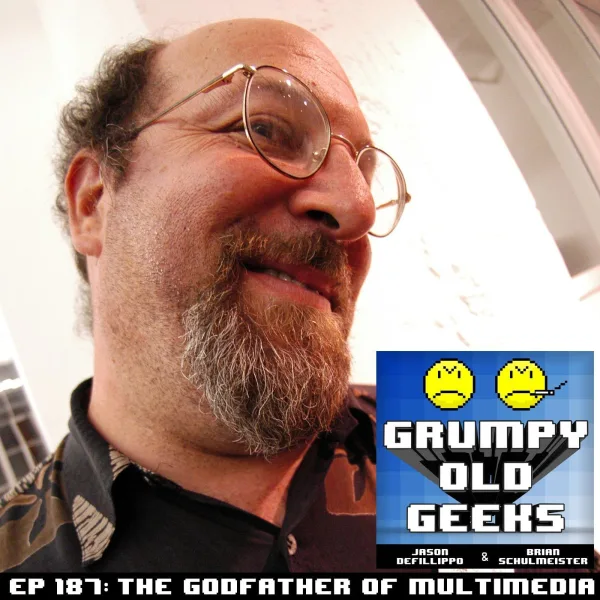
187: Marc Canter, The Godfather of Multimedia
The publisher’s audio length has changed since transcription. Ads may differ, so timestamps may be offset.
Summary
Jason DeFillippo speaks with Marc Canter about his early work combining music, video, and computers, including his recollection of programming music for Spy Hunter. They discuss the development of multimedia software, early film websites, the startup ecosystem, and Canter’s ideas for messaging and interactive video.
- Brian Schulmeister is away for the episode.
- Canter describes his political upbringing and early experiments with slides, video, and electronic music.
- He recalls programming music for Spy Hunter and exploring the intersection of art and computing.
- The conversation covers CD-ROMs, Director, Shockwave, and websites made for films.
- Canter criticizes parts of the startup ecosystem and discusses messaging and chatbots.
- He describes String of Pearls, an idea for connecting video selfies through a conversational interface.
- Canter recalls early blogging and OurMedia.org’s video uploads to the Internet Archive, then discusses YouTube’s approach to sharing video.
Key moments
-
Canter’s background and early experiments
Canter describes his family history and early projects involving slides, video, and electronic music.
-
Spy Hunter and multimedia
Canter recalls programming music for Spy Hunter and studying the intersection of art and computing.
-
CD-ROMs, Director, and film websites
The speakers discuss multimedia software, early internet work, and websites created for films.
-
Startups, messaging, and video
Canter discusses the software business, chatbots, and interactive sequences of video selfies.
-
Blogging and early internet video
Canter recalls early blogging, OurMedia.org’s video uploads, and YouTube’s approach to sharing video.
-
Connecting interactive videos
Canter describes combining selfie videos, chatbots, and AI so creators can connect and interact with videos.
-
Show support and credits
The closing credits give ways to support and contact Grumpy Old Geeks and credit its contributors.
-
Advertisements
Advertisements for a Bare Knuckle Fighting Championship cruise and QVC follow the closing credits.
Full transcript
-
This episode of Grumpy Old Geeks is brought to you by FreshBooks. Now, FreshBooks has created a super intuitive tool that makes creating and sending invoices ridiculously easy. You can use FreshBooks to create and send invoices in about 30 seconds. There's no formatting and no formulas. Just really simple, clean and professional looking invoices. You can add your own logo and color scheme so that your invoice reflects your brand. If you've ever had to do this by hand in a Word or Excel doc for, you know, sending manual invoices, you know it's a pain in the butt.
-
With FreshBooks, you just upload your logo and set your colors and never think about it again. When you email a client an invoice, FreshBooks can show you whether they've seen it or not, which is a game changer when you have to have those, hey, did you get my invoice conversations? There's also a super handy deposit feature so you can invoice for a payment up front when you're starting off a project. The FreshBooks dashboard has been curated to answer the one burning question for any small business owner. How's my business doing? No more guessing games on what's owed, overdue, or whether you're in the red.
-
For any questions whatsoever, FreshBooks's award-winning customer service is amazingly helpful, super friendly with zero attitude. Plus, a real live person usually answers in three rings or less. I've used this and no joke, they answer the phone and you get a real person who knows the platform and can help you right on the spot. FreshBooks has been redesigned from the ground up and custom built for exactly the way you work. Get ready for the simplest way to be more productive, organized, and most importantly, get paid quickly.
-
FreshBooks is offering a 30-day unrestricted free trial to the Grumpy Army. No credit card required to try it out. Seriously, no credit card. You've got nothing to lose and a ton to gain. Just go to FreshBooks.com slash Grumpy and enter Grumpy Old Geeks in the How Did You Hear About Us section. That's FreshBooks.com slash Grumpy and enter Grumpy Old Geeks in the How Did You Hear About Us section.
-
Grumpy Old Geeks, a weekly talk show hosted by Brian Schulmeister and Jason DeFilippo, discussing the finer points of what went wrong on the internet and who's to blame.
-
Welcome to Grumpy Old Geeks, the tech news show for adults. I am Jason DeFilippo, and I'm usually here with my co-host Brian Schulmeister, but he's off in Canada right now eating all the maple cookies that he will never bring back for me. So we did a special episode this week. We sat down with my old friend and basically digital royalty, Mark Cantor.
-
Mark has been in this business since he was a wee lad of 15 back in Chicago, and he tells us some great stories about all the different eras of technology and what he was doing in those eras and all the things that you probably know him for but never knew his name.
-
So Mark tells us some great stories. At the end of the interview, he tells us what he thinks is coming down the line, and it's a fascinating story. We're going to pick this up right at the beginning where he's telling us about his background in childhood and where he comes from. So please enjoy this episode with Mark Cantor, and next week we'll be back with our normal show.
-
And one last thing before I let you go. Please, if you can, go to grumpyoldgeeks.com slash survey and fill out our user survey. It takes less than 30 seconds. We're almost at our goal. So this hopefully is the last week we have to bug you about it, but pretty please with sugar on top. If you haven't done it yet, less than 30 seconds.
-
Grumpyoldgeeks.com slash survey. Now here's Mark. No, I'm a pretty radical person. Let me just say that my grandfather was a famous American communist, and he served a year in prison for Sacavanzetti, and he called the governor a murderer.
-
He came out of prison in 1929, November 1929. The capitalist system was crumbling around him. He picked up the family, my seven-year-old father, and he moved to Moscow. And he hung out in Moscow with John Reed, you know, the character that Warren Beatty played in Reds.
-
That's a real character, an American communist. Nice. And my grandfather was part of the history of American communism. And then my father was a, you know, a union organizer and got his hands on the transcripts of the Gary Powers U-2 spy plane trial.
-
Do you know what that is? Oh, yeah, yeah. The movie Bridges Spies with Tom Hanks. Yep. So my father self-published a book in 1960, 61, with the transcripts. And, you know, it showed the whole – all the evidence of the U-2 plane and the trial from the – transcript from the trial.
-
And then he was thanked by the U.S. government by being indicted in front of HUAC. You know, that was the House of Un-American Affairs. Oh, yeah. Joe McCarthy. And so we have the transcripts of that, my father testifying in front of Congress. Mr. Cantor, are you or have you ever been a member of the Communist Party?
-
I refuse to answer on the grounds of the Fifth Amendment. And if it's good enough for the mafia, it's good enough for me. So that's my upbringing. And I was raised as this kid who would run the tally. My father was a politician. And I was totally raised on politics.
-
And so by the time I'm 15, I'm already burned out on politics. So I took my idealism and applied it to software. So at 15, what kind of software was out there that you could even apply yourself to? Well, in those days, it was – this was pre-digital.
-
And so my friend Raul, in fact, the guy who is going to go work for Clinton who has the penthouse on Venice Beach where I'll be staying during Christmas. Raul and I proposed to the Museum of Science and Industry, which was in our neighborhood and on the south side of Chicago, we proposed a geodesic dome that would project slideshows and put smell into the air.
-
Did this involve Pauly Shore at all at that point? No, this is before Mr. Shore was born. Yeah, this is pre-Shore. This is 73. And then Raul and I went from that to videotaping the unveiling of the Chagall Mosaic, which is downtown, the former First National Bank.
-
You know, it's like this famous mosaic. So Raul and I in high school had a thing called a port-a-pack, and we videotaped the unveiling that Chagall and the old Mayor Daley were there, and my choir, the Chicago Children's Choir, was singing. And I produced a homemade video in 1974.
-
Damn. So that shows how long I've been into the intersection of technology and art. That's impressive. I was pooping in my nappies at 73. There you go. That's old school shit. But like I said, I'm not old. I'm not young. I'm in the middle.
-
You are. You definitely have more vim and vigor than I think I've ever had in my entire life. So I give you credit for that. And that certainly keeps me young. Absolutely. So does a lot of weed, I'm guessing. Yeah. But also, I'm thinking I'm really jealous of Brian's radio voice.
-
He must have like the compressor thing going and the whole, I've got the radio voice. Actually, Brian is talking on the same exact microphone that you're using. Really? Yeah. Am I coming off real radio-like? Yes, you come off radio-like.
-
I've just got the, I have no sleep because I have a two-month-old child voice. Oh, congratulations. Oh, thank you. You know, my favorite young father story is the thing that they don't tell us, right? So you go to Le Mans. Oh, there's so many things they don't tell you. Yeah. Yeah. So here's my very favorite young father thing.
-
So it's, you're in the delivery room. You know, you've tried to channel as much of the pain so the wife doesn't feel quite as bad. And you're there the whole fucking time. And as soon as she's done, she absolutely collapses, right? Just like the best slumber she's had in months, right?
-
At which point, here's this young child. And then the nurse turns to you and says, would you like to change the first diaper? Okay. Now, as young fathers know, there is this stuff called, and I'm already spacing the name. It's with an M. Mercurium or something.
-
Mercurium, right. And it's basically black tar. It's completely smellless, okay? But it's the consistency of tar. And it's what's in the body from the internal fallopian tube feeding. And once that stuff passes through, then the first external food goes into the digestive system.
-
And then from then on, it's a brown or a yellow or whatever the fuck, breastfeeding, et cetera. But that first kind of shit that comes through the shit is this black tar. And they never tell you about that. And so you're sitting there changing this diaper, of course, looking at this young baby.
-
And this black tar is coming out. It's like, what the fuck? They do put that in books now. So if you're smart enough to read ahead, you do. You see, you gained some knowledge of it just in an abstract fashion. But that means nothing compared to the oily black truth.
-
No, in fact, there you go. Now I'm dating my show title. Oily black truth. Yeah, because in fact, so I have twin sons. And today is their birthday. They're Halloween babies. Congratulations. And I have a total of five kids. So I'm all into that Mercurium shit.
-
Let's go back to the programming at 15 and your history with art and technology. Cool. I got to say, I found out something about you that I was not aware of by perusing your Wikipedia page. And I'm fanboying out for a second here.
-
You coded Peter Gunn into the Spy Hunter game, which I spent so many fucking hours playing that damn game. Dun, dun, dun, dun, dun, dun, dun, dun, dun. And it was done in 6800 assembler.
-
That is fantastic. I think 99% of the reason I played that game so religiously was the damn soundtrack. Yeah. And this is, again, so this is before the 68,000. It was when it was a 6800, which was an 8-bit processor. But I did have the processor dedicated to me.
-
And Henry Mancini himself had to show up and approve it. Oh, you're kidding me. I met the man. Oh, that is badass. That's pretty awesome. In 1983. 1983. Wow.
-
Okay. That's funny. So we have an employer in common because I used to work for Midway. Oh, my God. I was a game tester at Midway for a while. So I've been in probably the same building. Okay, right. And that's after they changed the name because when I was there, it was called Bally Midway.
-
I'm pretty sure. Actually, when I was there, I'm pretty sure it was still Bally Midway because they were still producing the Star Trek pinball machine. Okay. So we had the floor where the pinball machines were being produced. And then we'd go in the far back and we'd work on the video games.
-
This is- Fantastic, right. Yeah. Yeah. We were working on Revolution X. So I'll give you three quick stories. So first is that I worked for Dave Nutting Associates. So he was a subsidiary. He was an R&D group. And the reason why he was able to keep his name and his things separate was that Dave Nutting got the patent on frame buffer with video game.
-
Okay. In the 70s. And a guy named Nolan Bushnell was working for Dave Nutting when he wrote this thing called Pong. Okay. So Dave Nutting was the old school guy even by the time I get there. And I, in fact, had been accepted into grad school to learn about this thing called computer graphics.
-
And I got a job starting at $7,000 a month. What? In 1982. Dude, you should have had yachts. Okay. I'll do it. Who needs grad school? You know? So I became like the musician guy who would write these things called melody lines and sound effects for Ms.
-
No, sorry. For Professor Pac-Man. For Ms. Gorf. It was the sequel to Gorf. To 10-pin deluxe, which is a physical throw something down, a sliding thing. And then they borrowed me off. They shifted me over.
-
So this is all at Dave Nutting. And then I was like a resource that was lent to Midway itself, to Bally Midway, to work on this high-profile thing. Because they had this concept called, yeah, we're going to license music. And I was like, what?
-
Yeah, we're going to license music. And you think you're going to make that much money that you can afford to pay Henry Mancini? It's like, yeah, yeah, yeah. We're going to license this melody line. Can you program this melody line? With a 6800 assembler? You know, like, okay, dude. You know, that's how I got the gig.
-
Anyway, I'll tell you another early story for those days. So I went to a school called Oberlin. And I'm studying opera upstairs and electronic music and computers downstairs in the basement with no windows. Okay, so is this still in Chicago?
-
No, Oberlin is in Oberlin, Ohio. Okay. Outside of Cleveland. It's a famous undergrad school. Very big or echo and green liberal shit. The woman, Lena Dunham, who does girls. She's from Oberlin. Randy Dreyfuss.
-
Keith Jarrett. Eric Boghossian. Yeah, long-time liberal school. Oh, Oberlin was first for the first school to admit women. First school to admit blacks. And it was a major underground railroad stop during the pre-Civil War days.
-
Okay, so Oberlin's got a long school tradition in Ohio. I got in as a singer and I could be an opera singer. But they also had one of the first electronic music studios on the planet down in the basement. So I built a surge module. So I built a surge module in music system.
-
I was a cab driver in Chicago during the summer. I took that money. I built an analog patch synthesizer related to a Bukla or a Moog. And then they kicked out my guru. So of 26 full-time students, 24 of us left.
-
And I went to the Art Institute of Chicago. So I brought in and I walked into the Art Institute in 78, this analog music synthesizer in this giant Halliburton case, right? The fold-out aluminum case. And it had all these patchable modules. Well, it turned out the Art Institute of Chicago had a thing called a video synthesizer.
-
So this is when I coined the phrase. I know it's a long story. It's just as wrong to be a musician as an artist. Those are arbitrary terms based upon arbitrary technology. Paintbrush and violin. But now we can make music with our paintbrush.
-
We can paint with our violin. That's called a computer. So I coined that phrase in 1978. And that's when, you know, multimedia, at least for me, started. I got a degree from Oberlin called Intermedia because the term multimedia at the time meant drop the needle on a vinyl and then turn one of these kind of like microfilm slideshows.
-
And you literally have a pointer stick, you know, and you'd point at the thing and go, and notice the embryo here. Here's the woman's mammary gland or something. And that's what multimedia meant. And so intermedia was a new term. It had something to do with these computers.
-
This is all still fundamentally analog days before digital. But I was one of the founders of the Computer Music Society. I went to all the early SIGGraphs. And I was there right there. I was on a committee that helped form this thing called MIDI. Yeah.
-
So I was right when technology and music all became mainstream. You ruined my life for about four years or five years when I was just dealing with nothing but MIDI. So thanks for that. Yeah. I told them the thing was too slow.
-
It was a 32K speed. And so you could sit there with a rocker wheel or something, and you could go faster than that. And so the data would fall behind, and that created the propagation delay. Well, thanks for that, Mark. No problem.
-
Let's jump forward to the next decade. You know, what were you doing in the 90s? Well, so I was in an era that is completely forgotten, almost wiped from the memory banks. It was right when Wired magazine was rising. And it was more or less called the CD-ROM era.
-
It was the era right before the internet. Ah, but before you get to Wired, what about Mondo 2000 era? Same thing. Mondo 2000, Are You Serious, the Digital B-Ns, Michael Gosney's Digital B-Ns, a band called Da Cuckoo.
-
Da Cuckoo? Da Cuckoo, they had a 3D head as a lead singer. Okay, I don't remember them. No, but I totally remember Mondo 2000. I used to seek those things out to find them. Yeah, early VR, The Residents, Todd Rundgren, Ty Roberts had a thing called Ion.
-
They did a disc with David Bowie and a disc with Brian Eno. I had a band called the Media Band. There's a lot of money being spent. 85% of all those CD-ROMs were all created with director. Yes. Oh, let's get to director.
-
Yes. I made a number of my own CD-ROMs with director, and I even got paid for that in the late 90s. There you go. Back when we used to get paid for writing shit on the internet. Yeah, and the theory was that all these hundreds of thousands of people owe their jobs and their careers to me because I invented that.
-
Well, I'd like a refund, damn it. Okay, no problem. But I'll tell you what. I'll trade you 1% of your career for that. That means he's going to have to cut a foot off your kid. I wouldn't take that deal. Well, that's the problem with the subscription models.
-
We had the idea that you had this physical thing you bought. It went through a two-tier distribution system where boxes were printed up. We'd ship them to Ingram Micro D, the boxes would sit in a warehouse, and then the retailers would call Ingram Micro D and have to pay for the shipment of the box.
-
And then there was a whole issue of the difference between the MRSP of the suggested retail price and then what you actually paid. And then the issue was that the disk in the box went out of – went extinct and you had to get upgrades. So the internet to me had nothing to do with content.
-
Internet to me was software distribution. I miss the old days of the software in a box though. I mean my first real computer was an IBM XT. My first video game was Zill. I don't know if you remember Zill. Z-Y-L-L. Bought that at the store.
-
I don't know if you remember the old IBM – of course you remember the old IBM software. All of them were just these monotone, like really tan or blue hues. And we had stacks of them in my house because my mom was an AS400 programmer. So she bought us the XT so she could program on the side when she came home.
-
It didn't tell me that D-E-L star dot star when you're at root is a bad thing to do. So you're a bad mother but you know what? That's the way shit goes. But I just – I miss software in a box because you get it. You open it up and you get to read the manual.
-
You get before you – while you're installing it, you know. What are these manual things? Yeah. Nobody knows anymore. So dudes, are you watching Halt and Catch Fire? I can't watch it. I watched it for like the first 10 minutes and it just seemed so just dumb.
-
Dude, first of all, anytime you have a hot blonde who's a programmer – That's why I thought it was dumb because I'm like there were no chicks programming back then. First of all, she's fantastic. Okay. The current season that just ended, dude, I mean it's a fantastic show.
-
I can highly recommend it because it does capture exactly the era we're talking about from an entrepreneurial point of view. So I'm like in the room at that comm desk throwing those parties. That's me. That's my life in the 80s.
-
That's exactly what I was doing. So I can attest to that. In fact, I know a guy who worked for Phoenix, the Phoenix BIOS company. Remember that? Yeah. And you know what they did? They cloned the IBM BIOS. That's the first episode.
-
That's the first season of Halt and Catch Fire. It's cloning the IBM BIOS. And so I know the guy who actually did that, Rich Levendorf. Okay? I mean I was there, dude. And so now they've worked their way through online gaming. And now they're figuring out this thing called the NSF net.
-
Okay? And ARPANET. And what they're doing is they're figuring out how to build something called a browser. That's season four. Okay? And so the question is now they're intersecting with fucking Mark Andreessen. Yep. Or Andreessen. Yeah. They're going to fuck around. They're going to see if Andreessen buys them out or like buys the channel just to fuck with them.
-
You know? Okay. He becomes a Peter Thiel or not. Okay. I'll go back and watch it. I'll give it another shot. Because I met Andreessen back in Shambana way back in the day when Mosaic was out. I just went down there to hang out with a friend and she was just like banging some dude that was working at the supercomputer center.
-
And I just got to meet him way back then when he had hair. And also that's when they had this thing called Play-Doh. Right? So they had this huge online system. So that's why the culture at Shambane-Urbana, they got online. Right? Because they had this thing called the Play-Doh system which was this early educational software.
-
Online educational software coming out of Shambane-Urbana. It had a history. Yeah. No. It was a cool place. Definitely. They were doing some cool shit down there. Because honestly, there was nothing else to do because it is surrounded on all sides by corn.
-
That's it. It is corn for hundreds of miles in every direction. There's another story about Champagne-Urbana. John Cage did what is considered the first computer music piece ever in 1964 at Shambane-Urbana.
-
No way. Okay. Yeah. Cool. It's called harpsichord. But he did one of these things where they take out all the vowels just like they were doing with software companies. So harpsichord with no vowels. And that's a piece that Cage did in 64.
-
So an interesting thing was my director programmer that I had when I was at Rocktropolis, this girl Cindy, she was friends with Neil Gaiman. Okay, yeah. And Neil was in town to go to a John Cage simulcast at Virgin Records.
-
And we went to the Virgin Records right on Sunset. And it was past Highland. It was by my old- Anyway, it was on Sunset back in the day. So I got to meet Neil Gaiman there because he was going to do this because my director programmer is friends with Neil Gaiman.
-
And they couldn't figure out which one it was. So they ended up having to run to another store. The director programmer that I hired introduced me to Neil Gaiman, who was a fan of John Cage. So let's bring that full circle. That's full circle. And, dude, if you're studying Zen or you're doing spiritual VR, if you're into mushrooms or like there's so many connects into John Cage.
-
You know that he was a world-class expert in mushrooms. Mmm, tasty. So when he came to Oberlin, because my guru, Jerry John Mizell, studied with him at UC Davis, as a matter of fact. Okay, so now jump forward 20 years.
-
My guru invites John Cage to do a seminar with us electronic music students at Oberlin. So I go over to the house to meet John Cage. And John Cage comes to the door and he's holding a plate of wild mushrooms that he had picked on the way in from the airport.
-
And he had marinated them in tamari and they were like this whole Zen thing. And we sat around and he gave Zen sayings. And that was the seminar with John Cage. Nice. Yeah. So I was there. I'm one degree removed.
-
The other thing that my director programmer did back at Rocktropolis was she introduced me to Eric Idle. Okay, sure. We did a 24-hour turnaround when Monty Python discovered the internet back in 1995. They're like, we want to have Python Line.
-
Yeah. And we spent 24 hours without leaving our computers and we built the entire world of Python Line. Awesome. And I still have – I actually took a picture of me. I had a spy cam set up so I could get a picture of me demoing to Eric Idle.
-
And it was a Kinectics quick cam because that's all you could get back in the day. So it's 16 shades of gray. So I want to see – first of all, A, I want to see this photo. I'll send it to you, yeah. B, did the site ever go live? No, we didn't get the gig. We didn't get the gig. Wow. I still have the director files, but I can't open them anymore.
-
Okay, exactly. Now, and it was – and the theory was that it would be with .dcr. It would like run a Shockwave player. Yeah. Yeah, this is right when Shockwave was really coming into its thing. See, the problem was that – see, this is exactly when these two worlds intercollided because the average user had a 1,200 to 2,400 baud modem.
-
It would take an hour and a half to load the first page. And so that was why they bought Flash because Flash was optimized to only work with vectors. In fact, through the rest of the – That's when it was Future Splash at the beginning. Right, when they bought it, yeah.
-
And it was from Charlie Jackson who we had put out of business back in the 80s. So it was his kind of like revenge fuck, you know, that he's going to go undercut us. And meanwhile, I'm long gone from the company, right? And I had told them, you know, because you had all these different kind of data types in these channels.
-
I said, why don't you add a data type called vector-based artwork, right? So not everything's a bitmap. And if they had done that, they wouldn't have needed to bring in Flash. And they would have been able to leverage Lingo, which was their language.
-
Because what happened was the entire community got bifurcated between the old school director guys who used Lingo and the new school Flash guys. The Flash guys didn't even get bitmaps until the end of the decade and eventually got ActionScript. And it took 10 years for them to equal the functionality that director had, right?
-
So the whole world was fractured. And then along comes Dreamweaver and just like all these other things happened. But, you know, anyways, so the problem was that the Shockwave files were always too big. And so that's why it never worked online. Yeah, yeah.
-
Now, the Shockwave stuff was – I mean, it worked for us for quite some time because we used it when I was – at this point when I was at Rocktropolis doing the Python demo, in the other room, I was doing the same – I was building the website for The Phantom.
-
Do you remember that movie with Billy Zane? Yeah. I built that website and that got me into Paramount. And when I left Rocktropolis, I went straight to BoxStop, which is an end around – which is where I met Brian, by the way. This is where we became friends.
-
All right. So now this is an interesting tie-in. So at the time, it was very clear that Hollywood was shooting its toes off its feet because what we would do was that they would force people like you to go through this process of doing lost leader gigs.
-
It was something on spec or working below cost. Actually, no. That was after our – that was after my time. That was – at this point in my career, they're spending hundreds of thousands of dollars for every movie. I got in the sweet spot when – so we did the Phantom.
-
Then I moved to BoxStop to do Star Trek First Contact. They spent probably $500,000 or $600,000 on the Star Trek First Contact website. And then we moved up and kept going until it became a point where that took over where it was lost leader.
-
We finished Titanic. I did private parts. All right. So I did that website. We did Titanic. We did Deep Impact. Deep Impact was the last big movie I did. And who was the agency? Who was the agency? Paramount Motion Pictures. I worked on a lot. Wow. I was a head motion – I was a head programmer for Paramount Motion Pictures.
-
So we were doing all this stuff on the lot and it was under print advertising. Okay. And so which – So that was a very – it was a very short window. Right. It was about two years. What do you think, Brian? About two years? About two – yeah. Two to three years for the movie stuff. Music stuff lasted a little bit longer but not much.
-
Yeah, because you were doing – yeah. You were doing music and you went to Microsoft and were doing things for – what was the technology at Microsoft you were big in? Chrome something? Chrome – I can't even remember what it was called anymore. Yeah, but you guys were getting like – I was doing a bunch of different tech-exclusion stuff. So what was the Star Trek movie?
-
Which one? Like Star Trek 5? Star Trek First Contact. It was First Contact. So – That was way later. It was like 7 or 8, right? I think it was 5. 5, right? I think it was 5. No, no, no, no, no, no. Maybe 6? 5 is the one where they go find God. Oh, yeah, whatever. It was like 6 or 7.
-
This was basically what they were trying to rebrand the next gen as as the Wrath of Khan. That was like their attempt to do Wrath of Khan. And so we did VRML walkthroughs of the entire ship. We had the guy who invented VRML come into the office.
-
And unfortunately, I was sick that day, which pisses me off because he comes in. And I don't know if you guys remember. I did a site called Spew long ago. I was up for a webby for it. The guy comes in and he's like, where's Jason? He's like, oh, he's out sick. He's like, oh, man, I wanted to meet that guy.
-
I'm a fan of Spew. Like, ah! Yeah. Same thing happened with me. Robin Williams came by our booth at Macworld and wanted to meet me. And I was schmoozing or something. All right. So let me tell you a Star Trek story. And again, I'm dating myself. So Star Trek II used video work.
-
So this is before it was called Director. To do some animated storyboards. Okay. And the producer was Ralph Winter. So the scene was when Spock and Kirk are on a shuttle and they lose automatic control.
-
And they actually have to land the shuttle manually, like old-fashioned flying, you know? And so they have to land on the Enterprise without autopilot. And so, of course, they crash land and they have a net there to catch them.
-
And so we got to use a Ralph Winter quote on the Video Works II box. And it said, I saved $75,000 by using Video Works to storyboard Star Trek II.
-
Nice. It was a money quote, you know? It was like, you could, and it was, you know, high celebrity shit. He came to our party. He spoke at our event. You know, so I was going down to the studios in those days. And I'll never forget being out in Malibu with somebody named Ivan Reitman.
-
Oh, no. I've heard of him. Yeah. I've heard of that guy. So he said that. So I'm showing him. At that time, we had a, this is still fucking black and white Mac. There wasn't even a color Mac, right? Yeah. So I'm showing him these animated storyboards. He stands by the window in Malibu, right?
-
On the water. He literally holds up a glass of Chardonnay. He looks through the glass and he says, you know, we could do a lot with this technology. This is the true quote, right? Like 85, 86, that timeframe.
-
So anyway. So going back to Star Trek, the one thing I still have is I have all the director files. For, if you ever watch Star Trek and you're a fan of Star Trek, behind all of those screens were the pizza box Centra 610s.
-
Everything behind those screens were Centra 610s running director with animations built on director. And I still have those. And so, in fact, Jason, when we met first, I remember you telling me that story. Yep. Yep.
-
And then I told you the story of a guy named Michael Bacchus, B-A-C-K-E-S. Speaking of Wired, his company was on Wired Magazine, the cover, twice. The company was called Rocket Science. And I don't think they ever fucking shipped. But they were one of these like vaporware, hyped up CD-ROM things that Wired Magazine just loved.
-
Because Michael Bacchus came from Hollywood. And he became famous in the tech world because he's a guy who wrote all the pseudo screens for Jurassic Park. The first one where the fat guy is. Oh, the good one. Yeah. Right. Exactly.
-
The fat guy's sitting there and he sabotages and he lets the dinosaurs out so he can steal the embryos. Yeah. Newman. Newman. Newman. Yeah. All those screens were done in director. No, it's amazing how much, you know, it just, if you needed animation on a screen, there was no option.
-
You did director. We did it. We use it for Grease. You know, we had, we did so many games in, uh, at Paramount for all these movies. I think I worked on 25 movies at Paramount and every single one of them. Brian knows, uh, knows my programmer there, Mr. David Riegler.
-
Um, we did all of those in director. So there was a movie with, it was a remake with, uh, Bridget Fonda. It was little Nikita, right? Where like, no, it was called, it was actually called point of no return. Point of no return. Exactly. So the point of no return was the, the remake.
-
Okay. Yes. Yes. As she, they get her to turn on the corner from being a junkie to a, an assassin. They put her on a computer and teach her how to use these things called computers. And the thing that she's using is a, as a director thing.
-
Okay. So point of no return for just for my history is one of my favorite movies of all fucking time. So I'm a huge Bridget Fonda Mark. Yeah. I've seen that movie at least 30 times because God damn, she was hot. Yeah. No, in fact, the only thing hotter is the, is when she's in Jackie Brown and she fucks out, uh, Robert De Niro.
-
That's the hottest, you know, I still haven't gotten to that point in Jackie Brown. I've only seen half of it and I haven't gotten to that point yet. It's so worth it. And then when, and then she's just jabbing and jabbing, I'm going to give you a total spoiler. And at the end, she's just like, wow, she's like being this bitch. And Robert De Niro just turns to shut up and he just shoots her and kills her.
-
Well, thanks for the spoiler. I appreciate that. So I guess I don't have to. If it's taken you this long to get through the movie, I think it's really sick. I know, I know, I know. But to the sex scene where she says, so you want to fuck? And yeah, he just leans her up on the counter. It's this awesome scene. So anyway, it's a, it's a good movie.
-
Well, I'm going to get to the end now. It's a good movie. So what I want to talk about is what do you think about what's going on in tech now? Do you think we have too much tech? Are we, are we burnt the fuck out? Cause that's, you know, that's a common theme that Brian and I talk about on the show.
-
It's just like, there's just so much shit going on. And it's like, why aren't you curing cancer? Why are you giving us another fucking fart app? Yeah. Okay. So, okay. So you can directly, you can directly point at the startup ecosystem for that. Right. So Apple and Google are making money off the apps.
-
And so they encourage the apps. The VCs need people to pre-filter the startups. So they encourage the angels and the super angels and the accelerators and incubators do all that, which makes the VCs jobs easier, right? Uh, that then perpetuates these kinds of scam companies.
-
And we've seen even products as successful as vines go through a whole cycle, cash out and fucking Twitter buys them. And yet they still shut it down. And there never was a business model, right? I, I always remember, I remember another product in those days.
-
It was called delicious. Yeah. Yeah. Joshua Schecter. Yeah. Josh Schecter, who was a complete tool, but, uh, he wrote a great product, but it never had a business model. Nope. You know what his business model was. Yeah. It was to sell out.
-
And, and, um, it's a Fred Wilson who figured that out. Right. So all these guys are figuring this out. So, okay. So remember, so there's making money and there's what software is about. So you guys can sit around and talk about that. There's too much software, but the reality is that there's a lot of people.
-
Oh no, we talk about, there's too much bad software. Yeah. Well, okay. So this is how I parse the world. There are people who wake up in the morning time and they think they see software as a way to make money. And I wake up in the morning time and I see software is something that can create change.
-
And if you can make money along the way, great. Right. So my wife hates me for that, but you know, it's why I'm sitting in a small room now and I don't have all this money. Uh, and there's a side story about Cola in there. Uh, but, but the reality is, is that the software business is broken into lots of very clear markets.
-
Cause remember I left Silicon Valley, got out of the ecosystem. You moved to Ohio. Yeah. For six years I got out of the echo chamber. Right. And it was to, it was explicitly do that to see what it was like outside of the echo chamber and to see how software and technology affected society.
-
Okay. And this had to do with mainly about jobs. So it is possible. And you know, the company in Berlin, I think it's called rocket internet. Don't know them. Okay. So they're a fund and all they do as a fund. It's fund startups that clone us software ideas and then apply them to Poland or, you know, Romania or Russia.
-
We are coming up with four pierogies. Right. You can check in when you have a pierogi. Right. And you're probably one of the few people that even knows what a pierogi is. And then we can talk about the subtle differences between the Cleveland and the Chicago pierogi. Right. Okay.
-
And then, so Chicago had more poles in it than anywhere but Warsaw and Cleveland had more Hungarians in it than anywhere but Budapest. Right. So I'll give you a real good idea of who those two cities are.
-
And so meanwhile, each of those cities, Chicago, Cleveland, Budapest, Warsaw, each have cloned software industries which live in the shadow of Silicon Valley, New York, and London. Right. And so those, there are software companies there that thrive, who stay in business.
-
Half the shit is customized for enterprise. The other shit is just a clone and a copycat. And they live on the crumbs and they live underneath the radar. Okay. So you don't notice those people, but it is a big chunk of the industry.
-
What you notice are the ones who come to San Francisco, join YC Combinator. Fuck Y Combinator. Fuck them. In their eye holes. Fuck them in their eye holes. Right. So they upload it to Product Hunt. They go on. Fuck Product Hunt. Right. Fucking Stack Overflow and Hacker News.
-
Well, Stack Overflow has saved me millions of man hours. So I appreciate those guys. This is the ecosystem, right? And we're about to see, as of last week, when Twitter announces there are 300 people layoff, we have seen the precipice of this bubble economy.
-
And now we're going to start seeing it careening down. It may be imploding. It may be a slow shift. We'll have to see exactly how it happens. Intel, HP, Cisco, they're all doing layoffs. It's estimated that as many as 375,000 jobs will be affected because, you know, when the marketing lady from Cisco gets laid off, she can't go buy her new Mercedes.
-
You know, so the Mercedes dealership lays off. And then, and of course, what we're all very interested in is traffic and a restaurant costs. Right. So, and rent, rent, rent is really the big one because you can't live in San Francisco now.
-
You can't live there. And I live out here in Walnut Creek because of, yeah. Well, and you can't live in, you can't live in Southern California anymore either because everybody's moved from San Francisco down to here. Rent prices have shot through the roof. Or they moved out to Walnut Creek. Yeah. Because we have good schools here and we can jump on the BART, right?
-
So we can get into town. So, yeah. Now, okay. So what you're supposed to be talking about is either AR, VR or chatbots. And then, so then what I do is I simply parse it by saying, I don't do AR and VR and I'm all about the chatbots.
-
Okay. Why? Why are you all about the chatbots? I want to know this now. Okay. All right. Now, are you familiar with something called Cola Messenger? I remember when you were working with them, you sent me some invites. I signed up and then you got fired. I invented the product and I started the company.
-
All right. So trust me, I'm into messaging is the new OS, right? So if I'm in the visionary game, I was applying for patents two years ago where the user interface is inserted directly inside the chat messaging interface.
-
Okay. So that is what Apple does, what Google does, what WeChat does. All those people, they all do that. Do they have their patents dated February 19, 2015? Because Cola does. Okay. So that's the game I was playing. So I started this messaging company.
-
Actually, it was a pivot from something else. I hired a CEO. They did their thing. They fired me from my own company. I sue them. We settle. Now it's been two years. In the meantime, Cola refuses to do chatbots. So if you look at the one interview that this guy has ever done on video, it was with Robert Scoble.
-
So type in Robert Scoble, David Temkin, Cola, whatever. Up comes this video that's on Facebook. And for 18 minutes, he's pitching Cola. Now, the very first words that come out of Robert's mouth was, so how come there's no chatbots in Cola?
-
So Cola can insert in what they call bubbles. Basically, it's something built with Facebook React native. You ever heard of React? Okay. So it's JavaScript bubbles. And you could put any kind of interface into a messaging app. We ship, Cola ships with standard stuff.
-
But the theory is that it's a third-party developer platform that anybody could build their own interface and inside a messaging app. Okay, so that's where I was over two years ago. Now, in the interim time period where my ex-partner, who I had to sue, hates chatbots, you can assume I do the opposite of everything he does.
-
So I'm like, okay, it's about chatbots. So we had – in fact, he and I had a mutual friend, a guy named Adam Chayer. Don't know him. Well, he's the guy who did Siri. Oh, okay. And then they went and did something called Viv.
-
Oh, yeah, yeah, yeah, that guy. Yeah. Yeah. All right. So back in the springtime when I filed the lawsuit, I went to him because I was concerned that Temkin would be – how do you say it politely? Bad-mouthing me? So I thought it would be nice to, like, go to Adam and tell him my side of the story.
-
And he's pitching me Viv, you know, like, yeah, let's get Viv inside of Cola, you know, because Cola doesn't have the chatbot. And Viv is just the engine. It's not tied to a messenger platform, you know. Anyway, so that's when I started getting into chatbots. I've actually already pivoted a little bit, and I've shrunken down my extremely ambitious dreams.
-
But now I call it String of Pearls. Well, it's not – that's a very porn-centric kind of name. At least there's a happy ending with String of Pearls. You might want to do a little market research on that.
-
No, no, no. Okay, well, do you want to know what the most popular – what the Google version of String of Pearls is? Oh, I'm looking at it right now. It's a Chinese international diplomacy strategy. Well, not what I got. You must have a safe search on.
-
Okay. All right. Well, anyway, so – and then the other thing for me, String of Pearls, is a digital audio editing technique where you've got the audio waveform, and then you would put little nodes on the waveform, and as you move the node up and down, there's a line that changes, and that's the volume that you're putting to typically change the volume of the audio file.
-
And that's called String of Pearls. Right. But what I refer to String of Pearls is I'm talking about where video selfies are strung together using AI and a conversation. That sounds like the human centipede.
-
There you go. Whatever. Listen, I tried it at my daughters, and they liked it, so I'm happy. All right. So the idea is that you record these video selfies, and then you run recognition audio on the recording, and then the author goes and says, yeah, this is a keyword, and this is a keyword, and that's called semantic data, right?
-
And then you allow the author to attach other semantic data to this video, and then they choose a particular template, and you record a series of these videos, and you send that, and it creates a proxy bot, which is, you know, you're the puppeteer, and the chat bot is your proxy.
-
Now, dude, are you sitting down? Are you both sitting down? I'm sitting down, and I got to pee. I'm about to tell you something very heavy, okay? Because this is what I'm working on right now, okay? 20 years ago, I'm sitting next to Dave Weiner, and I'm rolling the joints.
-
I mean, literally. Eric Raymond calls, and, you know, he's doing this thing called the Cathedral and the Bazaar. Bazaar, yeah. Okay? All right? And then Dave's talking to this company called Netscape, and they've got this format for subscription, and Dave's got this metadata structure for a thing called an RSS thing.
-
And I'm sitting there rolling the joints as blogging is being invented. And, in fact, if you go look at Dave, and he has celebrated the 22nd anniversary of the first blog post. I can't because that asshole fucking blocked me, so. No, dude, just go to scripting.com.
-
Just type in Dave Weiner first blog post, okay? Yeah. I read it. About me. Okay. I was the subject matter of the first blog post, okay? Just to show you when I used to be famous, okay?
-
I used up my 15 minutes a long time ago. So, if blogging started 20 years ago, 10 years ago, YouTube started, right? And I was doing something called OurMedia.org with J.D. Lassica, and we were a front end to the Internet Archive.
-
Yeah, I remember him. You could upload videos into the Archive, which was great, except that YouTube came along and showed how to do that right, okay? Now, when we started blogging, no one knew about Monica Lewinsky, Arab Spring, Trent Lott, and all the shit that blogging would do.
-
And when Internet video started, we had no idea about PewDiePie and Twitch and all the shit that Internet video would bring us, right? And so, here we are today, and we have these selfie videos, right? But we still can't string together the videos in anything besides a playlist, and we can't interact with the videos with anything more than commenting.
-
So, that's what I'm attempting to do, is to merge chatbots with video selfies using the AI and put the power – who are we going to give the power to, Jason? The bloggers, the bloggers, the YouTubers, the creative people, the long tail, okay?
-
The Viners. Oh, wait. So, that's what I'm doing. I've been looking for the right terminology. I was calling it AI blogging. Who knows what the fuck? I've got string of pearls for now because you string together these videos, you know? Anyway, so that's where I'm at right now.
-
Big thanks to Mark for coming on the show. I hope you guys enjoyed that one. If you'd like to help support the show, please visit patreon.com slash GOG and sign up. Even as little as a buck a month helps keep us on the air. If you're cheap or broke but still want to support the show, please go to grumpyoldgeeks.com slash iTunes and leave us a glowing review and five stars.
-
Pretty please? Pretty please? And at the very least, please share the show with your friends. Grumpyoldgeeks.com is where you can listen to shows, leave feedback, ask us questions that we can read on the air, or find links to our awesome sponsors and stuff we like. We have our new subreddit at reddit.com slash r slash GOGpodcast.
-
We're also on Twitter at GOGpodcast and on Instagram at Grumpy Old Geeks. And please take our super fast user survey at grumpyoldgeeks.com slash survey. It'll take you less than 30 seconds, and it helps us know who the hell you are. We're almost at our goal. We are so close. So please, if you can, fill it out, and we'll never bug you again.
-
Intro music for the show is provided by the band Among Us. You can find them on iTunes, Spotify, and Apple Music, or get 10 exclusive tracks when you sponsor us on Patreon. Outro music for the show is provided by Andy Stochanski. You can follow Andy at twitter.com slash houseofandy, and he's also on SoundCloud at grumpyoldgeeks.com slash Andy, where you can listen to this song in its entirety.
-
Voiceovers for the show are provided by Robert Fogarty. You can check out his writing and editing services at scribblepinch.com. Show notes for this episode can be found at grumpyoldgeeks.com slash 187. There you will find links to where you can find Mark on the interweb, and also you can find links to previous episodes of the show and listen on the web or subscribe in your podcast player of choice.
-
That's where we roll, bitches! This January, Bare Knuckle Fighting Championship takes over the ocean. The inaugural Bruise Cruise sails from Miami to the Bahamas aboard the Norwegian Jewel. Three straight days with pool deck bare knuckle fights in the Caribbean.
-
Massive parties, beach events, DJs, cigars, tequila tastings, and non-stop action. The lineup reveals coming soon. Cabins are disappearing fast, and the prices won't stay this low. Reserve your spot with just $200 down at bkfsea.com.
-
At QVC, shopping is more than just checking out. It's discovering something new every day. Start with today's special value. Then, explore exciting finds across the brands and categories you love.
-
From beauty and fashion, to home, culinary, and outdoor living. Shop now at qvc.com.